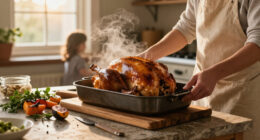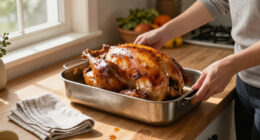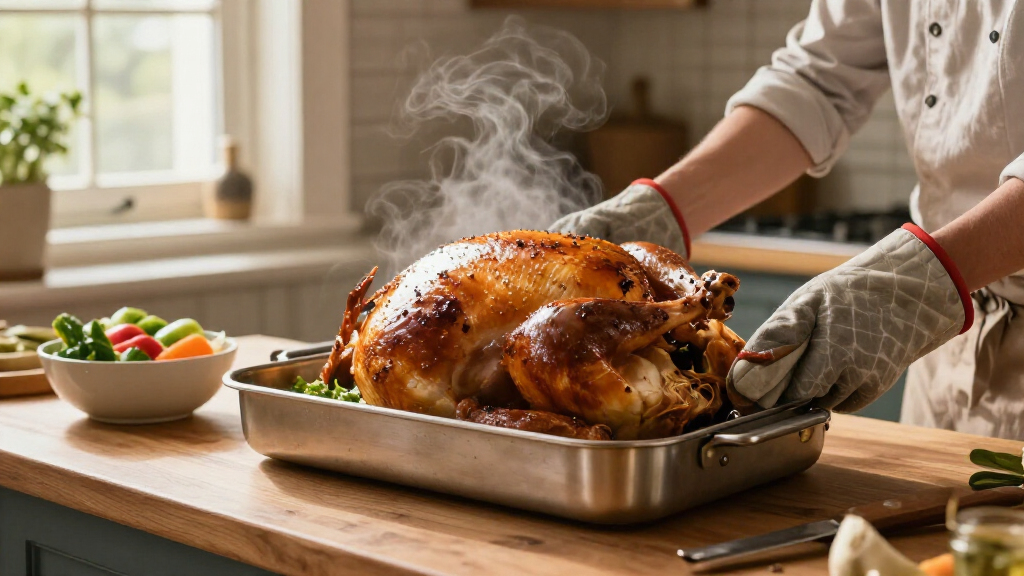

Turkey roasting pans are often sold in two broad styles: bare stainless steel and enamel-coated metal, commonly steel or cast iron. The real decision is whether you want a pan that is especially useful for browning and making gravy on the stovetop, or one whose smooth coating can make food release and cleanup easier. Both can roast a turkey well when sized and built appropriately, but neither material guarantees even cooking or easy handling on its own.

Get health and wellness essentials delivered free with Prime
- Fast, free delivery on millions of items
- Prime Video, Amazon Music and more included
- Member-only deals all year

Extra-Large Nonstick Turkey Roasting Pan with U-Shaped Rack, 18.7 x 13.6 in
- ✔ Material: Carbon steel
- ✔ Finish: Two-layer nonstick
- ✔ Rack: Removable U-shaped rack

EWFEN Nonstick Turkey Roasting Pan with U-Shaped Rack, 17 × 13 Inch
- ✔ Material: Carbon steel; description also references aluminized steel
- ✔ Finish: Nonstick
- ✔ Rack: U-shaped rack

Glad Nonstick Carbon Steel Roasting Pan with V-Shaped Rack, 15 x 10.3 Inches
- ✔ Material: Carbon steel
- ✔ Finish: Nonstick
- ✔ Rack: V-shaped iron rack
For cooks who plan to brown the bird, collect fond, and turn drippings into gravy in the roasting pan, stainless steel is usually the stronger all-purpose pick. Enamel is attractive to cooks who value a smooth, nonreactive surface and straightforward cleanup, provided they are comfortable handling a coating that can chip if struck or abused. Construction, handles, weight, and compatibility with the cooktop matter alongside the surface.
At a Glance
| Criteria | Stainless steel roasting pans | Enameled roasting pans | Winner |
|---|---|---|---|
| Browning and fond | Strong browning when the pan is heavy enough and properly preheated | Can brown well, but performance depends on base material and construction | A |
| Stovetop gravy use | Usually well suited to deglazing and gravy; verify burner compatibility | Often usable, but confirm the maker permits direct burner use | A |
| Cleanup and food release | Can develop stuck-on residue; soaking and scrubbing may be needed | Smooth surface is often easier to clean; browned bits can still stick | B |
| Durability | No coating to chip; can warp or discolor, especially in thin pans | Coating can chip or crack from impact or thermal shock | A |
| Weight and handling | Usually moderate weight, though gauge and size matter | Can be heavy, especially enameled cast iron; large pans are cumbersome | Depends |
| Price and value | Wide range; a sturdy pan can serve for many kinds of roasting | Often costs more; the premium buys coating and appearance, not automatically better roasting | A |
Extra-Large Nonstick Turkey Roasting Pan with U-Shaped Rack, 18.7 x 13.6 in
When turkey size is the deciding factor, this is the strongest fit in the lineup: it is designed for birds up to 26 pounds, more than the EWFEN’s stated 22-pound capacity. The removable U-shaped rack elevates the bird above drippings, and taking it out leaves a pan that can serve for casseroles or baked dishes. That extra flexibility helps justify choosing a large roaster even when it is not being used for a holiday turkey.We should plan carefully around the footprint. The pan measures 18.7 by 13.6 inches externally, with a stated minimum oven interior of 20 inches long, 15 inches wide, and 7 inches high. Those clearance requirements make it a poor default for compact ovens. Its two-layer nonstick coating is intended to aid food release, but hand washing is recommended to extend its life, so cleanup is less carefree than Glad’s dishwasher-safe instructions suggest. The 450°F ceiling is also lower than Glad’s 464°F limit, though neither product is listed as broiler safe. Overall, this option earns the top spot for capacity and documented fit details, provided our oven has room.
Pros:
- Designed for turkeys up to 26 pounds
- Removable U-shaped rack allows use as a casserole or baking pan
- External and internal dimensions help assess oven and food fit
- Two-layer nonstick coating and six-layer construction are designed for release and stability
Cons:
- Requires at least 20 inches of oven length, 15 inches of width, and 7 inches of height
- Hand washing is recommended to extend the coating’s lifespan
- Maximum oven temperature is 450°F
Best for: Cooks roasting a turkey up to the stated 26-pound capacity who have an oven with adequate clearance and want a removable rack for other dishes.
Not ideal for: People with compact ovens, those who want a smaller pan for routine roasting, or anyone prioritizing dishwasher-only care.
Bottom line: The most capable choice for a large turkey, as long as we confirm our oven can accommodate its broad footprint.
“The most capable choice for a large turkey, as long as we confirm our oven can accommodate its broad footprint.”
EWFEN Nonstick Turkey Roasting Pan with U-Shaped Rack, 17 × 13 Inch
EWFEN aims for a middle ground between Glad’s smaller pan and the Extra-Large model: it is designed to hold a turkey up to 22 pounds, while angled handles are intended to leave more cooking area inside the pan. Its U-shaped rack lifts the bird above grease and juices, a practical arrangement when we want drippings to collect below rather than pool around the roast. The stated capacity is substantial, but still below the Extra-Large pan’s 26-pound limit.The key drawback is uncertainty about fit. The product title says 17 by 13 inches, while the listed dimensions are 15 by 8 by 3 inches; the description also varies between aluminized steel and carbon steel. Those inconsistencies make it difficult to know how much turkey the pan can physically accommodate or whether it will fit our oven as expected. We should confirm dimensions with the seller before relying on the title. EWFEN’s maximum temperature is 450°F, a little below Glad’s 464°F, and no broiler or stovetop use is specified. It makes sense for buyers attracted to the capacity and handle layout who can resolve the sizing question first.
Pros:
- Designed to hold a turkey up to 22 pounds
- U-shaped rack raises the bird above collected grease and juices
- Angled handles are intended to preserve more cooking surface
- Nonstick coating is described as free of PTFE, PFOA, cadmium, and lead
Cons:
- Title dimensions conflict with the listed 15 x 8 x 3-inch dimensions
- Material description varies between aluminized steel and carbon steel
- 450°F maximum temperature is lower than Glad’s stated limit
Best for: Cooks seeking a roasting pan with a stated 22-pound turkey capacity and angled handles who can verify the actual dimensions before purchase.
Not ideal for: Anyone who needs dependable measurements to confirm oven clearance, or who wants the highest stated turkey capacity in this comparison.
Bottom line: A promising capacity-focused option, but only after we confirm the pan’s real dimensions and material.
“A promising capacity-focused option, but only after we confirm the pan’s real dimensions and material.”
Glad Nonstick Carbon Steel Roasting Pan with V-Shaped Rack, 15 x 10.3 Inches
Glad is the compact choice here. Its 15-by-10.3-inch pan and V-shaped iron rack are suited to smaller roasting jobs where a wide turkey pan would be awkward to store or fit. The rack is designed to improve airflow around meat and vegetables, while the nonstick coating can make releasing the roast and cleaning the pan easier. Compared with EWFEN and the Extra-Large model, Glad’s description does not promise a specific turkey weight capacity, so we should treat it as the pick for smaller birds and roasts rather than assume it fits a large holiday turkey.Its stated oven limit of 464°F is the highest of these three, but the practical restrictions matter: Glad is not broiler safe and is not for stovetop or open-flame use. The nonstick surface also calls for care with utensils and cleaning; abrasives and metal tools can damage it. Dishwasher-safe labeling may simplify cleanup, but gentle handling still helps protect the finish. The smaller format and clear dimensions make it easier to assess than EWFEN’s conflicting size details, while the Extra-Large pan remains the better documented choice for a large bird. Choose Glad when compactness is the priority and the intended roast fits.
Pros:
- Compact 15 x 10.3-inch pan is easier to fit and store than the larger options
- V-shaped rack is designed to promote airflow around the roast
- Nonstick surface supports food release and easier cleanup
- Stated oven limit of 464°F is the highest among these three pans
Cons:
- No specific turkey weight capacity is provided
- Not safe for broiler, stovetop, or open-flame use
- Metal utensils and abrasive cleaning can damage the nonstick surface
Best for: Cooks roasting smaller birds, meat, or vegetables who want a compact pan with a V-shaped rack and stated dishwasher-safe care.
Not ideal for: People planning a large turkey, or anyone who needs a pan that can move from oven to stovetop or under a broiler.
Bottom line: A sensible compact roaster for smaller birds and everyday roasting, but the lineup’s least certain choice for a full-size turkey.
“A sensible compact roaster for smaller birds and everyday roasting, but the lineup’s least certain choice for a full-size turkey.”
As an Amazon Associate we earn from qualifying purchases.
Key Differences
The clearest practical advantage of stainless steel appears after roasting. Its bare cooking surface encourages browning, and the browned bits left behind can be deglazed with stock or wine for gravy. Many stainless pans are also designed for stovetop use, though shoppers should check the product details and their own cooktop, especially with induction. A thin pan may heat unevenly or warp, so material alone is not enough: look for a substantial base and stable construction.
Enamel’s smooth, nonreactive surface can be easier to wash and avoids direct contact between acidic ingredients and bare metal. That can appeal to cooks who roast with citrus, wine, or tomato-based accompaniments. The tradeoff is the coating: a hard impact, rough utensil, or sudden temperature change may damage it. Enameled pans also vary widely. Steel versions may be relatively light, while cast iron can be very heavy, a meaningful drawback when lifting a hot turkey and its drippings.
For most households buying one pan primarily for an annual turkey, a well-built stainless model is the better value because it supports roasting, browning, and gravy-making without a vulnerable coating. Pay extra for enamel if ease of washing, nonreactivity, or serving presentation matters enough to justify its care requirements. In either category, prioritize a size that leaves room around the bird, secure handles, a stable rack, and oven-safe construction.
Detailed Comparison
Browning and fond (Stainless steel roasting pans wins — moderate)
Stainless steel wins by a moderate margin. Bare stainless can build a useful layer of browned drippings on the pan bottom, giving gravy more flavor after deglazing. Enamel can brown food too, but its exact results depend on the metal beneath the coating and the pan’s thickness. For a roast where pan gravy is central, stainless makes the process more dependable.
Stovetop gravy use (Stainless steel roasting pans wins — moderate)
Stainless steel wins by a moderate margin. Many stainless roasting pans can move from oven to burner, making it convenient to scrape up fond and simmer gravy in the same vessel. Enamel pans may also be stovetop-safe, but this cannot be assumed; some products or cooktops have restrictions. Check the maker’s instructions before relying on direct burner use.
Cleanup and food release (Enameled roasting pans wins — minor)
Enamel wins by a minor to moderate margin. Its smooth surface is often easier to wipe and is nonreactive, though it is not necessarily nonstick. Sugary glazes and baked-on drippings can still require soaking. Stainless steel can take more scrubbing, but it tolerates firmer cleaning methods without risking a coating.
Durability (Stainless steel roasting pans wins — moderate)
Stainless steel wins by a moderate margin. With no finish to chip, it is the safer choice for frequent use, metal utensils, and busy storage. It can still dent, discolor, or warp if it is poorly made or subjected to severe heat changes. Enamel can last for years with careful handling, but a chip is permanent and may expose the underlying metal.
Weight and handling (moderate difference)
This depends on the exact pan. Enameled cast iron is especially heavy, which can make transferring a loaded pan from oven to counter difficult. Enameled steel may be lighter, while thick stainless can also have substantial weight. Compare the empty pan’s weight, handle size, and grip; a turkey and hot juices add considerable load.
Price and value (Stainless steel roasting pans wins — moderate)
Stainless steel wins for most buyers by a moderate margin. A sturdy stainless pan often costs less than a comparable enameled option and can cover a wider range of tasks. Higher-priced enamel is worth it for cooks who value its surface and appearance and will handle it carefully. A premium finish does not by itself guarantee better heat distribution or roasting results.
Stainless steel roasting pans: Pros and Cons
Pros:
- Excellent surface for browning drippings and building gravy fond
- Usually suitable for deglazing on the stovetop when the model allows it
- No coating to chip or crack
- Often a strong value as an all-purpose roasting pan
Cons:
- Stuck-on food may take more effort to clean
- Thin models can heat unevenly or warp
- May discolor over time
Enameled roasting pans: Pros and Cons
Pros:
- Smooth, nonreactive surface can simplify cleanup
- Can be attractive enough to bring to the table
- Can brown effectively when its underlying construction is sound
Cons:
- Coating can chip or crack from impact or thermal shock
- Stovetop suitability varies by model and cooktop
- Enameled cast iron can be difficult to lift when loaded
- Often costs more without guaranteeing better roasting
Who Should Choose What
Choose Stainless steel roasting pans if:
- You regularly make gravy from pan drippings and want to deglaze in the roasting pan.
- You want one durable pan for turkey, other roasts, and vegetables.
- You prefer a lower-maintenance finish that can handle robust cleaning.
Choose Enameled roasting pans if:
- You value a smooth, nonreactive surface and easier cleanup more than fond development.
- You want a presentable pan that can go from oven to table.
- You will handle the coating carefully and have verified compatibility with your cooktop.
Skip both if: Skip either style if the pan is too small for your usual turkey, lacks secure handles, or is too heavy for you to lift safely when full; choose a lighter, correctly sized roasting pan instead.
Value for Money
For most buyers, stainless steel offers better value. A solidly built pan supports turkey roasting, other oven meals, and stovetop gravy, and its bare surface does not require protection from chips. Spending more on enamel can make sense if easier cleanup, a nonreactive interior, or serving appearance is a priority. The premium is less compelling if the pan will be used only once a year and stored where it may get knocked around. Compare construction and handling before paying for the finish.
Final Verdict
Choose a sturdy stainless steel roasting pan if you want the better all-purpose tool, especially when pan gravy is part of the meal. Its advantages in browning, burner use, and resistance to coating damage matter more to most turkey cooks than enamel’s easier cleanup. Choose enamel if its smooth surface and presentation are worth the added care, and verify the exact pan’s weight and cooktop compatibility. The deciding factor is whether you value reliable fond and long-term toughness or a more forgiving cleanup surface.
Frequently Asked Questions
Which roasting pan is better for turkey gravy?
Stainless steel is usually the better choice because it develops browned fond that can be deglazed into gravy. Confirm that the pan is rated for direct stovetop use before placing it on a burner.
Is an enameled roasting pan nonstick?
No. The smooth coating may release food more readily and can be easier to clean, but it does not guarantee nonstick performance. Sugary glazes and drippings can still bake onto the surface.
Can an enameled pan go on the stovetop?
Some can, but the answer depends on the pan’s construction and the cooktop. Check the manufacturer’s instructions, particularly for induction, and avoid sudden temperature changes that could damage the coating.
Is stainless steel worth choosing if I roast turkey only once a year?
Usually, yes, if you also want to roast other foods or make gravy in the pan. If cleanup and presentation matter more and the pan will be used infrequently, enamel may be worth the extra cost.