
If you want thorough cleaning, a lidar-equipped robot vacuum often performs better, especially in complex or dark spaces, thanks to its precise mapping and obstacle detection. Cameras excel in well-lit, simple layouts and can adapt quickly to changing environments, but struggle in darkness or cluttered areas. To find out which system suits your home best and how each handles challenges, explore the details ahead for a clearer comparison.
Key Takeaways
- Lidar offers more accurate mapping and obstacle detection, especially in darkness, leading to more thorough cleaning.
- Camera navigation excels in complex, cluttered layouts and adapts quickly to environmental changes.
- Lidar performs better in low-light or dark environments, maintaining consistent cleaning, unlike cameras that need ambient light.
- Cameras are more budget-friendly initially but may require more repairs, whereas lidar systems are more durable with lower long-term costs.
- Overall, lidar-based robots tend to clean more efficiently due to precise navigation and mapping capabilities.
How Do Lidar and Camera Navigation Work in Robot Vacuums?

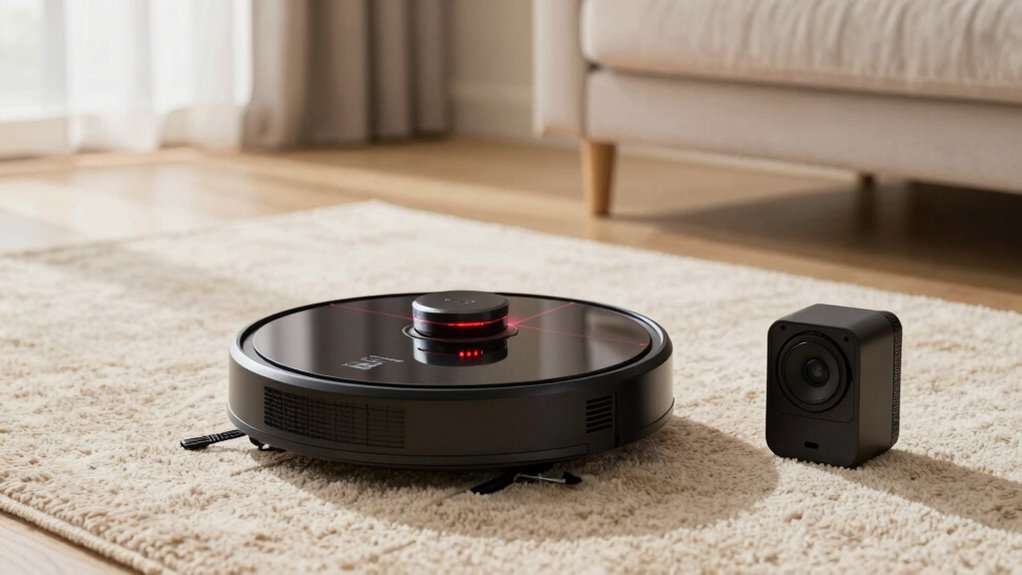
Robot vacuums rely on lidar and camera systems to navigate efficiently around your home. Lidar provides precise mapping accuracy by emitting laser beams that create detailed 3D maps of your space, helping the vacuum understand its surroundings. Cameras, on the other hand, capture visual data, enabling obstacle detection and recognition of furniture, walls, and hazards. Together, these technologies allow your vacuum to develop an accurate layout of your home, avoiding missed spots and repeated paths. Obstacle detection is enhanced as lidar quickly senses objects in real-time, while cameras offer additional context, identifying delicate or transparent items. This combined approach ensures thorough cleaning, minimizes collisions, and adapts seamlessly to changes in your environment. Additionally, Smart Strategies for Effective Personal Finance Planning emphasize the importance of investing in advanced technology to maximize efficiency. Sensor technology plays a crucial role in how these systems sync and operate effectively. Overall, lidar and camera systems work synergistically to optimize navigation and cleaning performance.
What Are the Main Advantages of Lidar-Based Robot Vacuums?
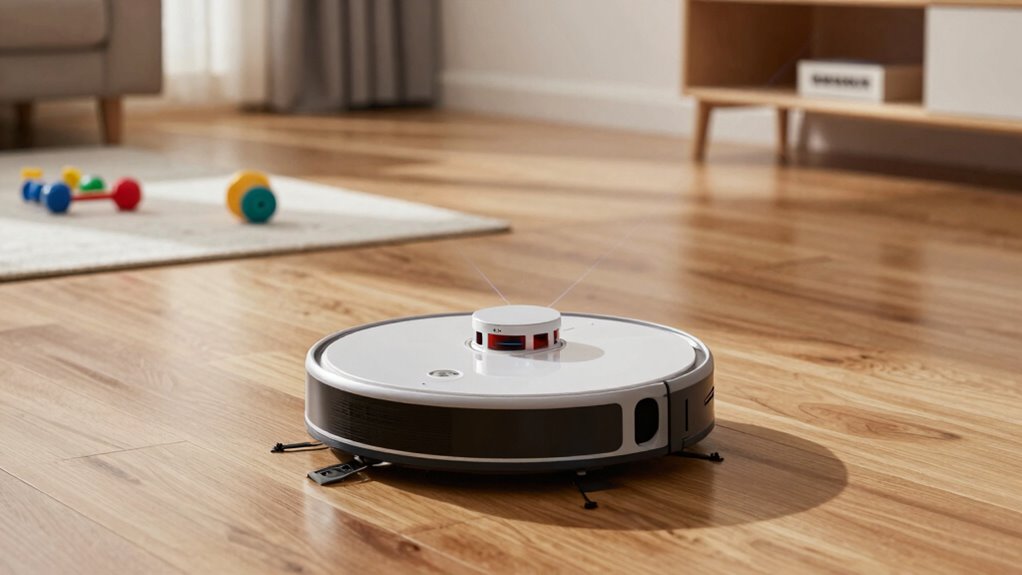
Lidar technology offers several key advantages that considerably enhance the performance of robot vacuums. It provides superior mapping accuracy, allowing your robot to create detailed floor plans quickly. This precise mapping helps the device navigate efficiently, covering every corner without redundancy. Lidar also excels at obstacle detection, identifying objects in real-time to avoid collisions and prevent damage. Its ability to function effectively in low light or dark environments ensures consistent cleaning. The following table summarizes these benefits:
| Advantage | Description | Impact |
|---|---|---|
| Mapping Accuracy | Creates detailed, reliable floor maps | Better coverage, fewer misses |
| Obstacle Detection | Detects objects quickly, avoiding obstacles | Safer, smoother navigation |
| Low-Light Performance | Operates well in dark conditions | Uninterrupted cleaning |
Additionally, Lidar sensors continuously update the map as the robot moves, allowing for dynamic adjustments that improve overall cleaning efficiency. These advanced sensing technologies are crucial for maintaining optimal performance in various environments. For example, real-time updating enables the robot to adapt to changes in the environment promptly, ensuring thorough cleaning.
When Do Camera Navigation Robots Perform Best?

Camera navigation robots excel in complex floor plans and obstacle-rich environments where precise vision is essential. They can adapt quickly to changing layouts and identify obstacles more accurately than other systems. If your home has lots of furniture or irregular spaces, this kind of robot is likely to perform at its best. Additionally, commercial kitchen equipment often requires detailed mapping, making camera navigation especially effective. Since they rely heavily on vision-based mapping, they are also well-suited for environments where detailed surface recognition is crucial. Their ability to process visual data in real-time enables them to navigate challenging layouts more efficiently. Moreover, advances in sensor technology continue to enhance their accuracy and reliability in diverse settings. For example, improvements in machine learning algorithms are helping these robots better interpret complex visual data.
Complex Floor Plans
Ever wonder when camera navigation vacuums excel on complex floor plans? These robots shine when your home has intricate layouts that challenge their mapping accuracy. Cameras can capture detailed visuals, allowing the vacuum to build precise maps even with many rooms, narrow corridors, or irregular shapes. Their obstacle detection capabilities help avoid furniture and tight spaces, ensuring thorough cleaning without getting stuck. Unlike lidar, which sometimes struggles with small or transparent objects, cameras can better interpret visual cues in complex environments. This makes them ideal for homes with complex floor plans, where detailed mapping and accurate obstacle detection are vital. When your space demands nuanced navigation, camera-based vacuums often perform better, delivering a more efficient and comprehensive clean.
Obstacle-Rich Environments
In homes crowded with furniture, narrow passages, and clutter, navigation becomes more complex for robotic vacuums. Camera navigation excels here because it can recognize obstacles like pet hair, cords, and clutter visually, adjusting its path dynamically. This is especially helpful for carpet cleaning, where debris and pet hair can hide under furniture or in tight spots. Cameras help the robot avoid getting stuck or missing areas, ensuring thorough cleaning. While lidar may struggle with small or transparent objects, cameras provide detailed environment awareness, making them ideal for obstacle-rich environments. If your home has lots of clutter or pet hair, a camera navigation robot can adapt better, delivering more effective cleaning in tricky, obstacle-dense spaces. Additionally, sensor technology plays a crucial role in how well these robots perform in complex environments, with cameras offering superior visual detail for obstacle detection. Moreover, visual perception allows these robots to better interpret their surroundings, further enhancing their ability to navigate safely and efficiently. Furthermore, environmental awareness ensures that the robot can adjust its cleaning strategy based on the surrounding conditions, optimizing coverage and effectiveness. Incorporating advanced sensors can further improve the robot’s ability to handle diverse obstacles and improve overall cleaning performance. Recent innovations in sensor integration are also enhancing how these vacuums adapt to rapidly changing environments, making them even more reliable.
Which Navigation System Is More Accurate for Mapping Your Home?
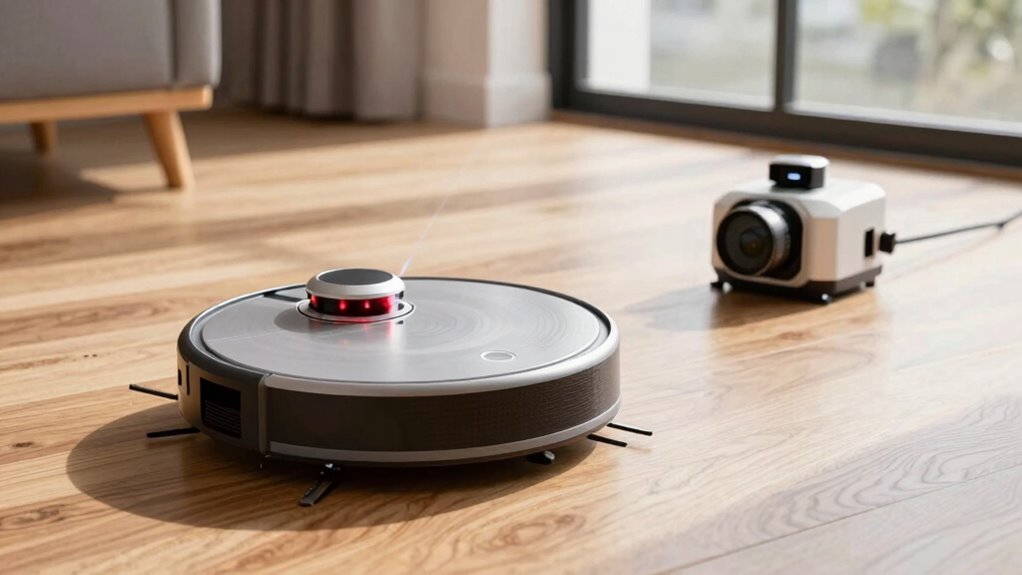
When it comes to choosing a robot vacuum, the accuracy of its navigation system can make all the difference in how well it maps your home. Lidar systems generally offer superior mapping accuracy, creating precise, detailed maps by measuring distances with laser beams. This allows for better obstacle detection, helping the vacuum avoid furniture and other hazards. Cameras, on the other hand, rely on visual data and can struggle with exact mapping, especially in complex layouts or cluttered environments. While cameras may excel in real-time obstacle detection, their overall mapping precision often falls short compared to lidar. If you want thorough, reliable navigation and an accurate home map, a lidar-based system is typically more effective. This ensures your robot cleans efficiently without missing spots or running into obstacles. Lidar technology provides consistent performance regardless of lighting conditions, making it a more dependable choice for comprehensive home coverage.
How Do Lidar and Camera Systems Handle Low-Light or Dark Conditions?
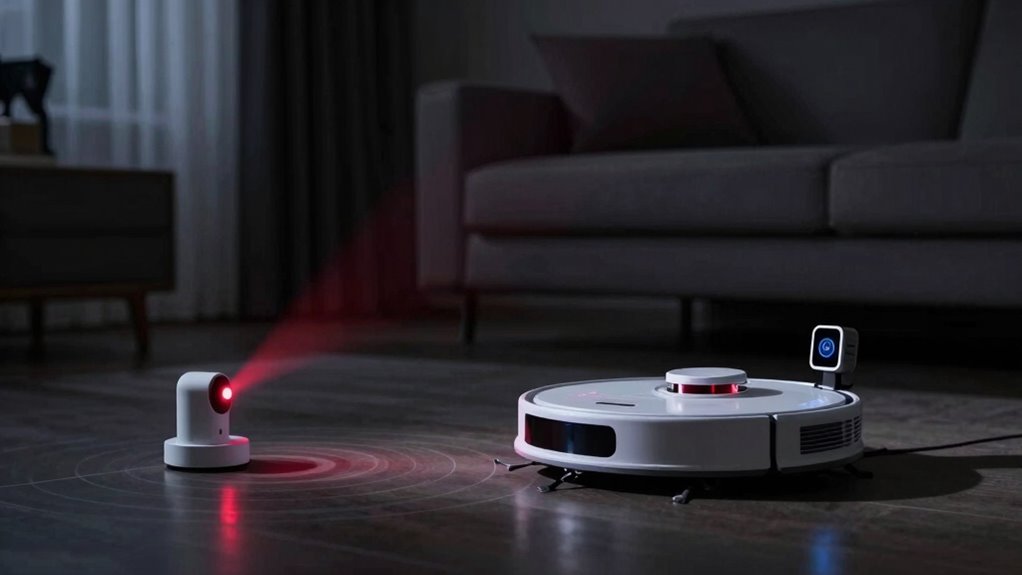
Lidar systems maintain their accuracy even in complete darkness by using laser pulses to map your home. Camera-based systems, however, struggle in low-light conditions, often requiring additional lighting or infrared technology. Understanding these differences helps you choose the right robot vacuum for your home’s lighting environment. Additionally, lighting conditions can significantly impact the effectiveness of camera navigation systems, so assessing your home’s lighting is crucial when selecting a model. Since sensor technology plays a vital role in navigation success, evaluating the specific capabilities of each system ensures optimal cleaning performance. Furthermore, advancements in sensor performance are continually improving the adaptability of navigation systems, enabling them to operate more effectively across various environments.
Lidar’s Nighttime Precision
During nighttime or in low-light conditions, lidar systems excel at maintaining precise navigation because they actively emit laser pulses to measure distances, unaffected by darkness. This capability guarantees reliable nighttime accuracy, allowing your robot vacuum to map and clean effectively even when lights are off. Unlike cameras, lidar doesn’t rely on ambient light, so its low light performance stays consistent regardless of the environment’s brightness. You’ll notice that lidar-driven vacuums can navigate around furniture, detect obstacles, and follow cleaning paths precisely in darkness. This active sensing makes lidar especially valuable in situations where lighting conditions are poor, giving you confidence that your vacuum can perform well without extra lighting or adjustments. In low-light environments, lidar’s nighttime precision keeps your home clean without missing spots.
Camera’s Low-Light Challenges
While lidar systems shine in low-light conditions by actively emitting laser pulses, camera-based sensors face significant challenges in darkness. Poor lighting conditions reduce image clarity, making it harder for your robot to identify obstacles or map the area accurately. This impacts sensor reliability, especially when natural light is minimal or uneven. You might notice that your robot struggles with:
- Detecting dark-colored objects
- Maneuvering shadowed areas
- Recognizing obstacles in dim lighting
- Maintaining consistent mapping accuracy
- Avoiding missed or false detections
Ultimately, camera systems rely heavily on ambient light, so their effectiveness diminishes in darkness. For reliable cleaning in low-light environments, lidar’s active sensing gives it a vital advantage over camera-based navigation, ensuring your robot keeps a steady, accurate course. Low-light performance is a crucial factor when choosing between these navigation systems.
What Are the Cost Differences Between Lidar and Camera Robot Vacuums?
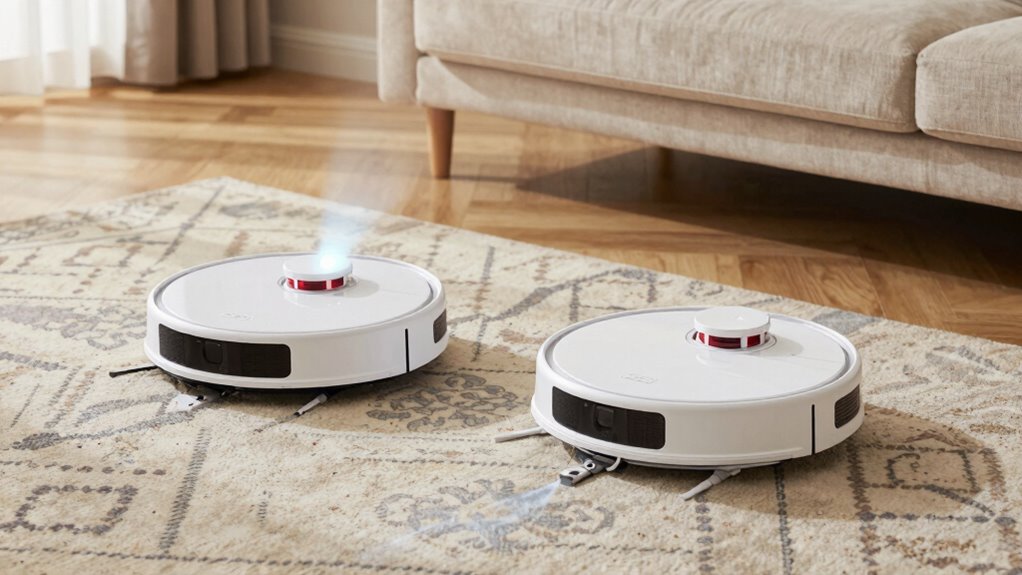
Understanding the cost differences between lidar and camera robot vacuums can help you make a more informed decision. Generally, lidar models are pricier upfront but tend to have lower maintenance costs due to their durable sensors. Camera vacuums are more budget-friendly initially but may require more frequent repairs or replacements, especially if the camera system gets damaged or obscured. Here’s a quick comparison:
| Feature | Lidar Robot Vacuums | Camera Robot Vacuums |
|---|---|---|
| Price Comparison | Higher initial cost | Lower initial cost |
| Maintenance Costs | Usually lower long-term | Potentially higher repairs |
| Sensor Durability | Very durable | Less durable, prone to damage |
| Software Updates | Less frequent, more costly | Easier and cheaper to update |
| Overall Investment | Higher upfront, long-term savings | Cheaper initially, possible ongoing costs |
This table highlights key differences, helping you weigh your options better. Additionally, sensor durability plays a crucial role in the long-term performance and maintenance expenses of these devices. Moreover, considering software update frequency can impact the device’s security and functionality over time. It’s also important to evaluate how sensor quality affects navigation efficiency and cleaning performance over the device’s lifespan.
What Are the Main Challenges and Limitations of Each Navigation Tech?
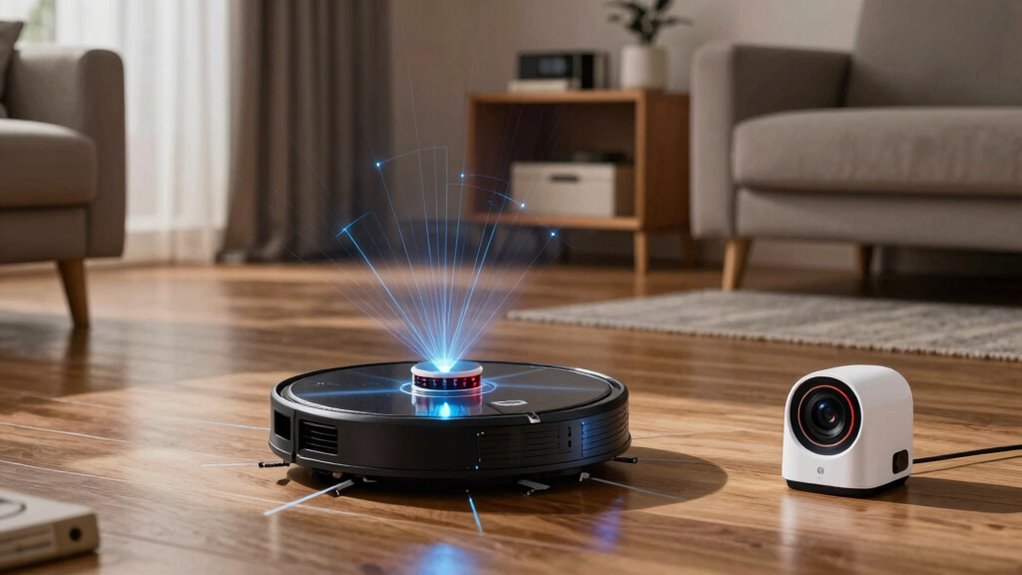
Both lidar and camera navigation systems face unique challenges that can impact their effectiveness in different environments. Sensor limitations often restrict performance; lidar may struggle with transparent or reflective surfaces, while cameras can be hindered by poor lighting. Software complexity also plays a role, as advanced algorithms are needed to process data accurately, increasing the risk of errors. Additionally, environmental factors can affect navigation:
- Lidar’s difficulty in detecting glass or mirrors
- Camera’s reliance on consistent lighting conditions
- Obstructions blocking sensors
- Limited ability to interpret complex scenes
- Increased processing demands due to complex software
These limitations mean each system may underperform in certain settings, requiring you to consider their strengths and weaknesses before choosing a navigation tech for your home.
Which Robot Vacuum Navigation Technology Is Better for Your Home?
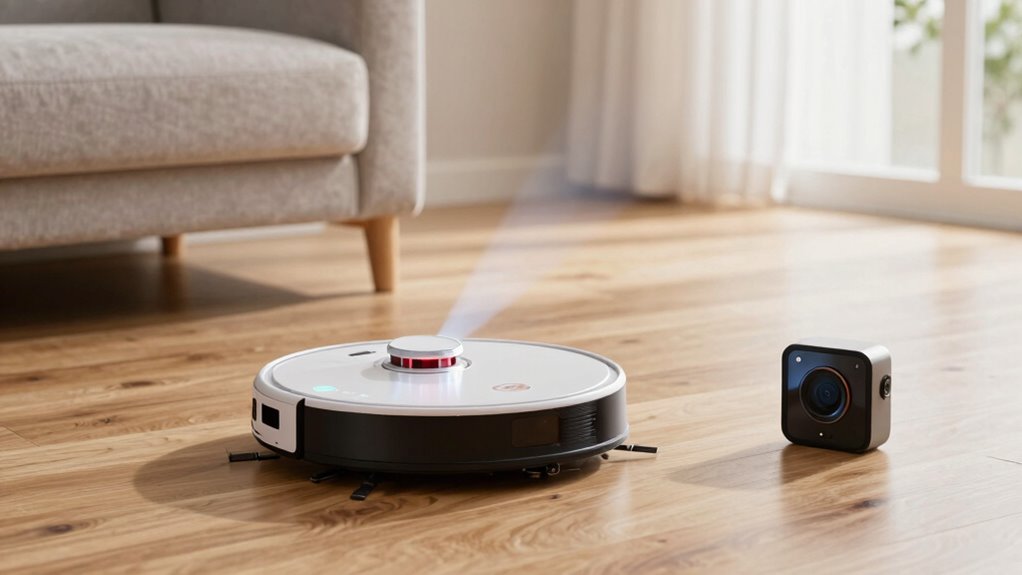
Choosing the right robot vacuum navigation technology depends on your home’s specific layout and lighting conditions. If your home has complex rooms or dark areas, lidar-based models offer precise mapping and efficient cleaning. They excel with sensor integration, providing accurate navigation even in low-light environments. On the other hand, camera navigation works well in well-lit spaces and can adapt to dynamic changes, but may struggle in dim areas. Consider battery longevity when choosing—lidar models often have longer-lasting batteries due to their efficient routes. If you want thorough coverage and better performance in varied lighting, lidar is usually the better choice. However, if your home is simpler and well-lit, camera navigation might be sufficient and more budget-friendly. The right choice depends on your specific home conditions and cleaning priorities.
Frequently Asked Questions
How Do Lidar and Camera Systems Affect Battery Life?
Lidar systems generally consume more power than camera systems, affecting your robot vacuum’s battery efficiency. The higher power consumption means lidar-equipped vacuums may run out of battery faster, requiring more frequent recharging. Camera systems tend to use less energy, helping your device conserve power and extend cleaning time. So, if battery life is a priority, a camera-based navigation system can offer better power efficiency for your cleaning sessions.
Can Lidar or Camera Navigation Prevent Pet Hair Tangles?
Think of lidar and camera navigation as your vacuum’s loyal guides—yes, they can help with pet hair management. Lidar’s precise navigation accuracy allows it to avoid areas prone to tangles, while cameras can detect pet hair buildup, adjusting routes accordingly. While neither can completely prevent pet hair tangles, they improve cleaning efficiency, reducing the chances of hair clogging the brushes. With smarter navigation, your vacuum tackles pet hair more effectively.
Are There Privacy Concerns With Camera-Based Robot Vacuums?
Yes, camera-based robot vacuums can raise privacy concerns, especially related to facial recognition. When your vacuum maps your home, it captures images that could be misused or hacked. You might worry about sensitive areas or personal items being recorded. To protect your privacy, check if the device offers data encryption, local storage, or the ability to disable cameras. Being aware of these risks helps you make informed decisions about using camera-based vacuums.
How Do Navigation Methods Impact Cleaning Speed?
Navigation methods directly impact your cleaning speed by affecting mapping accuracy and obstacle detection. Lidar typically provides faster, more precise mapping, allowing your robot to cover areas efficiently without missing spots. Cameras may slow down cleaning because they need extra time for obstacle detection and detailed mapping, especially in complex spaces. Overall, lidar-based vacuums often clean quicker because they navigate more accurately and avoid obstacles more effectively.
Do These Systems Require Frequent Software Updates?
Yes, these systems do require frequent software updates—because who doesn’t love a good reboot? You’ll find yourself chasing the latest updates to guarantee software stability and ideal navigation. Update frequency varies, but ignoring them risks bugs and sluggish performance. So, you get to enjoy the thrill of constant tech maintenance, all while your vacuum pretends to be a futuristic cleaning wizard, but only with the right software spells.
Conclusion
Ultimately, choosing between lidar and camera navigation depends on your home’s layout and your cleaning priorities. Do you want pinpoint accuracy and quick mapping, or do you prefer a more budget-friendly option that still gets the job done? Think about how each system handles obstacles and darkness. Whichever you pick, you’ll enjoy a cleaner home—so which technology will you trust to keep your space spotless? The right choice makes all the difference.