
For most buyers, I’d start with the AUVON Dual Channel TENS Unit: its two channels and reusable pads offer a practical balance of control and flexibility. The OMRON Max Power Relief is a strong alternative for shoppers who prefer an established, straightforward device, while the Comfytemp 3-in-1 Rechargeable suits people who want more than TENS functionality in one unit. The main tradeoffs are wired versus wireless pad connections, control simplicity versus a wider selection of modes, and general-purpose pads versus shapes designed for particular areas. No single setup will suit every body area or routine. Read on for how the eight options compare and which one fits your needs.
Key Takeaways
- AUVON Dual Channel is the most balanced starting point in this group, pairing two-channel operation with reusable pads rather than leaning only on a high mode count.
- OMRON Max Power Relief stands apart as a more established, straightforward alternative; shoppers who want extensive mode variety may prefer one of the 24- or 30-mode models.
- Wireless designs from MASTOGO and Comfytemp reduce cables between the unit and pads, but buyers should weigh that convenience against their preferred controls and setup.
- AVCOO’s 12-pad package and Comfytemp’s specialized pads address different needs: broader pad supply versus placement aimed at lower-back, neck, and shoulder areas.
- Mode count alone does not determine fit. This lineup ranges from 12 to 30 modes, but pad layout, channel setup, charging, and ease of operation can matter more in regular use.
| AUVON Dual Channel TENS Unit Muscle Stimulator with 20 Modes and Reusable Electrode Pads |  | Best for Flexible Two-Area Treatment | Modes: 20 | Channels: Dual channel with independent control | Electrode pad sizes: 2-inch square and 2-by-4-inch | VIEW LATEST PRICE | See Our Full Breakdown |
| OMRON Max Power Relief TENS Unit Muscle Stimulator |  | Best for Straightforward, Brand-Familiar Use | Power source: 2 AAA batteries | Pad type: Reusable, washable pads | Pad life: Approximately 10 uses per pad | VIEW LATEST PRICE | See Our Full Breakdown |
| MASTOGO 12 Modes Wireless TENS Unit Muscle Stimulator for Pain Relief | 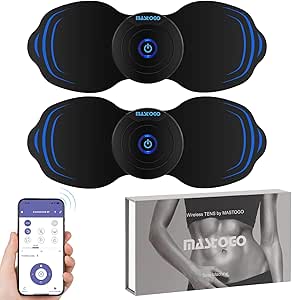 | Best Wireless Pick for TENS and EMS | Modes: 12 total: 6 TENS and 6 EMS | Connectivity: Bluetooth | Battery: USB rechargeable; full charge in 2 hours | VIEW LATEST PRICE | See Our Full Breakdown |
| Comfytemp 30 Modes Wireless TENS Unit Muscle Stimulator for Pain Relief |  | Best for Wireless Mode Variety | Modes: 30 | Intensity levels: 20 | Electrode pads: 4: 2 butterfly-shaped and 2 line-shaped | VIEW LATEST PRICE | See Our Full Breakdown |
| Comfytemp 3-in-1 TENS Unit Muscle Stimulator for Pain Relief, Rechargeable |  | Best for Screen-Based, Long-Running Sessions | Modes: 20 | Intensity levels: 20 | Timer: 10–60 minutes | VIEW LATEST PRICE | See Our Full Breakdown |
| AUVON 24 Modes TENS Unit Muscle Stimulator for Pain Relief |  | Best for Long Sessions | Modes: 24 | Battery: Rechargeable lithium battery; up to 10 hours of use | Electrode pads: 8 reusable square pads | VIEW LATEST PRICE | See Our Full Breakdown |
| AVCOO 30 Modes TENS EMS Unit Muscle Stimulator for Pain Relief, 12 Pcs Pads |  | Best for TENS and EMS Flexibility | Functions: TENS and EMS | Modes: 30 | Intensity levels: 30 | VIEW LATEST PRICE | See Our Full Breakdown |
| Comfytemp TENS Unit with Specialized Pads for Lower Back & Neck Shoulder Pain Relief |  | Best for Targeted Back and Neck Coverage | Display: 2.76-inch clear screen | Channels: Dual | Modes: 20 customizable modes | VIEW LATEST PRICE | See Our Full Breakdown |
| portable TENS units for pain relief | Modes | Intensity levels | Electrode pads |
|---|---|---|---|
| AUVON Dual Channel TENS Unit M | 20 | — | — |
| OMRON Max Power Relief TENS Un | — | — | — |
| MASTOGO 12 Modes Wireless TENS | 12 total: 6 TENS and 6 EMS | 1–20 | 4 TENS pads and 2 small electrode pads |
| Comfytemp 30 Modes Wireless TE | 30 | 20 | 4: 2 butterfly-shaped and 2 line-shaped |
| Comfytemp 3-in-1 TENS Unit Mus | 20 | 20 | 10 total: 2 large and 8 small |
| AUVON 24 Modes TENS Unit Muscl | 24 | — | 8 reusable square pads |
| AVCOO 30 Modes TENS EMS Unit M | 30 | 30 | — |
| Comfytemp TENS Unit with Speci | 20 customizable modes | 20 adjustable levels | — |
More Details on Our Top Picks
AUVON Dual Channel TENS Unit Muscle Stimulator with 20 Modes and Reusable Electrode Pads
The AUVON Dual Channel is a strong fit for buyers who want a wired, rechargeable unit that can treat two areas with separate intensity control. Its 20 preset modes offer more starting points than the OMRON Max Power Relief’s simpler treatment setup, while the two pad sizes give you options for smaller spots or broader coverage. That flexibility may be useful for, say, a shoulder and knee in the same session, without relying on a phone app. The tradeoff is the lead wires: compared with the wireless MASTOGO, this AUVON is less convenient to wear while moving around. It also asks the user to choose settings and place pads carefully; it is not a substitute for medical advice, and some users should avoid TENS unless cleared by a clinician.
Pros:- Independent dual-channel control allows separate intensity adjustment for two areas.
- Twenty preset modes provide a range of treatment patterns to try.
- Includes both 2-inch square and 2-by-4-inch pads for different coverage needs.
- Rechargeable design includes a pouch and pad holder for storage.
Cons:- Lead wires are less convenient for movement than the wireless MASTOGO or Comfytemp models.
- Choosing among modes and positioning pads may take some trial and care.
- Reusable pads can lose adhesion and need replacement with extended use.
Best for: People who want independent control for two treatment areas and prefer physical controls over app-based operation.
Not ideal for: Buyers who need hands-free wireless use, or anyone with a pacemaker, epilepsy, pregnancy, or another condition that calls for clinician guidance before TENS use.
- Modes:20
- Channels:Dual channel with independent control
- Electrode pad sizes:2-inch square and 2-by-4-inch
- Rechargeable:Yes
- Included pads:Four 2-inch square pads and four 2-by-4-inch pads
- Included accessories:Two lead wires, USB cable, user manual, pad holder, and pouch
- Warranty:24 months
Our verdict“Choose this AUVON if you want rechargeable, dual-area control and a broad pad selection without depending on a smartphone.”
OMRON Max Power Relief TENS Unit Muscle Stimulator
The OMRON Max Power Relief suits buyers who want a compact, battery-powered TENS unit and washable pads rather than a rechargeable device with many controls. Its operation is a simpler proposition than the Comfytemp 3-in-1, which offers 20 modes, adjustable intensity, and a larger screen but may take longer to learn. That simplicity can be appealing for occasional targeted sessions at home or when traveling. The tradeoff is less flexibility: this model relies on 2 AAA batteries, and its treatment schedule and pad life are limited by the supplied information. The listing also gives conflicting session guidance—15 minutes per treatment in the cons and up to 30 minutes as the maximum therapy duration—so buyers should check the product instructions and follow professional advice rather than assume a session length.
Pros:- Compact design is suited to home use or carrying on the go.
- Runs on widely available 2 AAA batteries rather than requiring a USB charging routine.
- Reusable, washable pads can be cleaned between uses.
- A simpler setup may suit users who do not want app controls or extensive mode selection.
Cons:- Battery-powered operation differs from the rechargeable AUVON and Comfytemp options.
- Pads are for one patient only and are listed for approximately 10 uses per pad.
- Supplied session-duration details conflict, so users need to check the manual for guidance.
Best for: People seeking a compact, basic TENS option with washable pads and battery power for occasional targeted use.
Not ideal for: Buyers who want rechargeable power, detailed dual-channel customization, or clear, consistent session-duration guidance from the available product information.
- Power source:2 AAA batteries
- Pad type:Reusable, washable pads
- Pad life:Approximately 10 uses per pad
- Maximum therapy duration:30 minutes per session
- Sessions per day:Up to 3
- Portability:Compact design
- Treatment use:Targeted relief for muscle soreness, joint pain, and chronic discomfort
Our verdict“Pick the OMRON for compact, uncomplicated battery-powered sessions, but choose another model if rechargeable power or broader customization matters more.”
MASTOGO 12 Modes Wireless TENS Unit Muscle Stimulator for Pain Relief
The MASTOGO wireless unit is the lineup’s clearest choice for buyers who want both TENS and EMS modes without wearing a control box connected by leads. It divides its 12 presets into six TENS and six EMS modes, with intensity levels from 1 to 20 and a timer, so users can adjust a session through the app. Compared with the Comfytemp 30 Modes Wireless unit, MASTOGO has fewer modes, but its stated TENS/EMS split makes the two types of stimulation easier to distinguish when choosing. The convenience comes with a dependence on Bluetooth app control: it is a weaker fit for people who prefer standalone buttons or do not want a phone involved. Its battery is rechargeable, though the supplied details do not specify runtime, which may matter for frequent use away from charging.
Pros:- Wireless format avoids lead wires during use.
- Includes six TENS and six EMS presets for two kinds of stimulation.
- Intensity adjusts across 20 levels, with a 1-to-60-minute timer.
- USB-rechargeable battery is listed as reaching a full charge in two hours.
Cons:- Full operation depends on a smartphone app and Bluetooth connection.
- Twelve presets offer fewer choices than the Comfytemp wireless model’s 30 modes.
- Battery runtime is not specified, making frequent-use planning harder.
Best for: Smartphone users who want a wireless stimulator with clearly separated TENS and EMS presets for home or travel.
Not ideal for: People who want a screen or controls independent of an app, or frequent users who need a stated battery-runtime figure before choosing.
- Modes:12 total: 6 TENS and 6 EMS
- Connectivity:Bluetooth
- Battery:USB rechargeable; full charge in 2 hours
- Intensity levels:1–20
- Timer:1–60 minutes
- Electrode pads:4 TENS pads and 2 small electrode pads
- Control:Smartphone app
Our verdict“Choose MASTOGO if wireless app control and a defined mix of TENS and EMS modes matter more than a large preset library.”
Comfytemp 30 Modes Wireless TENS Unit Muscle Stimulator for Pain Relief
For buyers who want a wireless setup and a broad menu of presets, the Comfytemp 30 Modes offers more variety than the MASTOGO’s 12 modes. Its 20 intensity levels add room to adjust stimulation, while the app-based controls keep a separate handheld controller out of the way. The included butterfly and line-shaped pads also give the kit a different approach to coverage than the AUVON’s conventional square and rectangular pads. This makes it a better match for people willing to use a phone as part of treatment, not for anyone who expects a fully independent unit. The product data does not specify battery runtime, and the stated limit of two TENS units with separate controls may complicate plans to manage multiple units at once.
Pros:- Thirty modes offer more preset variety than the MASTOGO’s 12.
- Twenty intensity levels support adjustments within a session.
- Wireless design supports hands-free use without lead wires.
- Includes two butterfly-shaped and two line-shaped electrode pads.
Cons:- App control is required for full functionality.
- Battery life is not specified in the supplied product data.
- The stated limit of two TENS units with separate controls may restrict multi-unit use.
Best for: App-comfortable users who want a wireless TENS unit with many preset options and two distinct pad shapes.
Not ideal for: People who need a controller that works without a smartphone, a published battery-runtime figure, or simple coordination of multiple units.
- Modes:30
- Intensity levels:20
- Electrode pads:4: 2 butterfly-shaped and 2 line-shaped
- Butterfly pad size:5.2 by 2.4 inches
- Line pad size:3.5 by 2.8 inches
- App control:Yes
- Compatibility:iOS and Android
- Rechargeable:Yes
Our verdict“Choose this Comfytemp if you want wireless use and a large preset selection and are comfortable managing treatment through an app.”
Comfytemp 3-in-1 TENS Unit Muscle Stimulator for Pain Relief, Rechargeable
The Comfytemp 3-in-1 is a practical pick for buyers who prefer a screen and physical unit over the app-first controls of the wireless Comfytemp and MASTOGO. Its 20 modes and 20 intensity levels allow more adjustment than the OMRON’s simpler format, while independent dual channels can help users set different levels for two areas. The stated battery life of up to 21 hours is a particular advantage for people who do not want to recharge after every few sessions. Ten included pads—two large and eight small—also offer more pad options than the MASTOGO kit. The tradeoff is a learning curve: DIY settings can reward experimentation but may be less straightforward for beginners, and the pads need proper care to remain reusable.
Pros:- Up to 21 hours of stated battery life reduces charging frequency.
- Independent dual channels allow separate intensity settings for two areas.
- Large HD screen is designed to make operation easier to see.
- Ten pads, including large and small options, support different treatment areas.
Cons:- DIY settings and multiple options may take time to learn.
- Pads require proper maintenance for repeated use.
- Its screen-based unit is less convenient for hands-free wear than the wireless Comfytemp.
Best for: Users who want a rechargeable, screen-based unit for repeated sessions, with separate controls for two treatment areas and multiple pad sizes.
Not ideal for: Beginners who want the simplest setup, or buyers seeking wireless, app-controlled use rather than a unit with screen-based controls.
- Modes:20
- Intensity levels:20
- Timer:10–60 minutes
- Battery life:Up to 21 hours
- Electrode pads:10 total: 2 large and 8 small
- Channels:Dual channel with independent control
- Display:Large HD screen
- Rechargeable:Yes
Our verdict“Choose this Comfytemp if you value long stated battery life, a visible screen, and independent dual-channel control over wireless app convenience.”
AUVON 24 Modes TENS Unit Muscle Stimulator for Pain Relief
The AUVON makes sense for buyers who want a rechargeable unit with a stated runtime and a straightforward set of reusable pads. Its battery is rated for up to 10 hours, while the included eight square electrodes and two lead wires give you flexibility to place pads across more than one treatment area. Compared with the AVCOO 30 Modes TENS EMS Unit, this AUVON offers fewer modes and does not list EMS, but its simpler TENS-focused setup may suit people who want pain-relief sessions without as many program choices. The tradeoff is that setup still takes some familiarity, and the supplied information does not specify its size or weight for travel planning. It is also unsuitable for some users, including people with pacemakers, pregnant women, and people with epilepsy.
Pros:- Rechargeable battery is rated for up to 10 hours of use
- Eight reusable square electrode pads support flexible placement
- Two lead wires allow connection of multiple pads
- Twenty-four pre-programmed modes provide options without the AVCOO’s 30-mode menu
Cons:- Requires some familiarity with setup and operation
- Does not list EMS functionality
- Not suitable for people with pacemakers, pregnant women, or people with epilepsy
Best for: People who want a rechargeable TENS unit with a stated battery runtime and enough reusable pads for flexible at-home placement
Not ideal for: Buyers seeking TENS and EMS functions in one device, or anyone who needs a particularly simple first-use setup without learning pad placement and controls
- Modes:24
- Battery:Rechargeable lithium battery; up to 10 hours of use
- Electrode pads:8 reusable square pads
- Lead wires:2
- Charging cable:Type-C cable included
- Warranty:12 months
Our verdict“Choose the AUVON if you want a rechargeable, TENS-focused unit with a stated runtime and multiple reusable pads, and skip it if you need EMS or a simpler setup.”
AVCOO 30 Modes TENS EMS Unit Muscle Stimulator for Pain Relief, 12 Pcs Pads
The AVCOO stands apart for combining TENS and EMS functions with 30 modes and 30 intensity levels, giving buyers more adjustment choices than the TENS-focused AUVON 24 Modes model. That range can be useful if you want one compact device for different stimulation preferences, while its 12 included reusable pads offer more placement options than the AUVON’s eight. At a listed 0.09 lb and 4.8 by 1.3 by 0.5 inches, it is also the clearest travel-oriented pick in this group by stated size and weight. The tradeoff is a potentially crowded menu: people new to electrical stimulation may find 30 modes harder to sort through. Its 30-hour battery-life claim is substantial, but the provided details do not identify a charging method.
Pros:- Combines TENS and EMS functions in one unit
- Thirty modes and 30 intensity levels allow broad adjustment
- Includes 12 reusable pads for varied placement
- Listed weight and dimensions make its compact travel form easy to gauge
Cons:- Thirty modes may feel overwhelming to new users
- Charging method is not specified in the supplied product details
- Electrical stimulation may not suit every user
Best for: Travelers and home users who want both TENS and EMS functions, extensive intensity adjustment, and a larger set of pads
Not ideal for: First-time users who prefer a small, clearly guided set of programs, or buyers who need a specified charging method before choosing a portable device
- Functions:TENS and EMS
- Modes:30
- Intensity levels:30
- Battery life:30 hours
- Weight:0.09 lb
- Size:4.8 x 1.3 x 0.5 inches
- Pads included:12 reusable pieces
Our verdict“Pick the AVCOO if you want a lightweight TENS-and-EMS device with many settings and pads, but choose a simpler model if a short learning curve matters more.”
Comfytemp TENS Unit with Specialized Pads for Lower Back & Neck Shoulder Pain Relief
The Comfytemp is the most area-focused choice here: specialized oversized pads and named body-area modes make it appealing for people targeting the lower back, neck, shoulders, or hips. Its 2.76-inch screen and 20 adjustable intensity levels also give more visible control than the AVCOO, whose supplied details do not list a display. The dual-channel design and upgraded four-snap connection are aimed at stable stimulation, while the carrying case helps keep the device and accessories together between home and travel use. In exchange, the Comfytemp’s battery life is not specified, and the instructions are described as limited for first-time users. The accessory details also warn that pads and accessories are sold separately, so buyers should check what is included before relying on the specialized-pad setup.
Pros:- Specialized oversized pads are designed for common areas such as the back and shoulders
- Named body-area modes help tailor selection to the intended treatment area
- Large 2.76-inch display and 20 intensity levels support visible adjustment
- Carrying case provides a place to store the device and accessories
Cons:- Battery life is not specified
- First-time setup guidance is limited
- Some pads and accessories may require separate purchase
Best for: People seeking a portable unit with body-area settings and larger pads for targeted sessions on the lower back, neck, shoulders, or hips
Not ideal for: First-time TENS users who need detailed setup guidance, or buyers who want clearly stated battery life and confirmed included replacement accessories
- Display:2.76-inch clear screen
- Channels:Dual
- Modes:20 customizable modes
- Intensity levels:20 adjustable levels
- Body-area modes:BACK, LIMBS, SHLDR, JOINT, ABD., HIP
- Included accessories:Specialized oversized pads, universal pads, carrying case
- Connection design:Upgraded 4-snap design
Our verdict“Choose the Comfytemp for targeted back and neck coverage with a large screen and area-specific modes, but look elsewhere if battery details or beginner guidance are priorities.”

How We Picked
I compared these eight portable TENS units by the features that shape day-to-day pain-relief routines: control simplicity, channel and mode options, pad quantity and design, portability, and power setup. I gave more weight to practical flexibility and ease of placement than to a high mode count on its own, since extra settings are only useful when a buyer can comfortably operate the device and position its pads.
The ranking favors devices that appear broadly adaptable without making setup needlessly complicated. Specialized pads, wireless operation, rechargeable power, and added EMS functionality can be valuable, but each is most useful for a particular buyer; those options rank higher for their intended use, not as universal upgrades. Product names and listed features guide this comparison, and individual comfort or results can vary.
Factors to Consider When Choosing Portable TENS Units For Pain Relief
Before choosing a unit, match its setup to where and how you expect to use it. A long feature list can distract from practical questions such as whether the pads can be placed comfortably, whether the controls are easy to reach, and how much charging or replacement-parts planning your routine requires.
Match Pad Shape and Placement to the Area
Think about the body areas you expect to treat before choosing by mode count. Specialized pads can make placement more intuitive for targeted areas, while standard reusable pads may offer greater flexibility across different locations. Check how many pads come with the unit and whether its layout supports the placements described in the instructions. A larger pad supply can be useful when you want several placement options, but it does not mean every pad should be used at once. Avoid assuming a shape designed for one area will fit another comfortably. Follow the device directions and ask a healthcare professional about placement if you are uncertain.
Choose Wired or Wireless Based on Your Routine
Wireless pads reduce the visible cable connection and can feel less restrictive when you move around during a session. They also place more responsibility on the pad units themselves, including charging and keeping track of separate pieces. Wired systems add leads to manage, yet the central device may be easier to adjust without moving the pads. Think about whether you plan to sit still or want fewer wires around you, rather than treating wireless as automatically better. Check what the package includes and how its components recharge or connect. For a first device, a setup you can place and operate reliably is more useful than a feature you may rarely use.
Prioritize Usable Controls Over More Modes
A larger mode selection can offer more ways to adjust a session, but it can also add menu choices without making routine setup easier. Consider whether you can quickly find intensity controls and understand what each setting does. The 12-, 20-, 24-, and 30-mode labels in this roundup show how wide the feature range is, not which option will feel best to you. If you want a simple routine, clear controls may matter more than browsing through presets. If you like adjusting settings, a broader selection could be useful, provided the instructions are clear. Start with the manufacturer’s directions and change settings gradually.
Check Power and Replacement Needs
Power setup affects whether the device fits into your regular routine. A rechargeable model avoids frequent battery changes but needs access to charging and a plan for keeping it ready. Other designs may use replaceable batteries, so check the device specifications before assuming how it is powered. Pads are consumable parts: their lifespan depends on care, storage, skin preparation, and frequency of use. Find out which replacement pads fit the unit and whether the included quantity suits your anticipated use. A device with convenient charging is less helpful if compatible pads are difficult for you to source.
Decide Whether You Need TENS Alone or Added Functions
A TENS unit focused on pain-relief sessions may be the simpler choice if you want one clear purpose. A combined TENS and EMS device or a 3-in-1 model may appeal if you have a specific reason to use its additional functions, but more functions can mean more settings to learn. Read the product instructions to distinguish the intended use of each mode rather than assuming they do the same job. Added functionality is not automatically a better fit for pain relief. If you are unsure whether a function or placement is appropriate for your situation, ask a qualified clinician before using it. Choose the least complicated device that matches your actual needs.
Frequently Asked Questions
Is a 30-mode TENS unit a better choice than a 12-mode model?
Not automatically. More modes provide a broader menu, but they do not guarantee greater comfort or better results for an individual. A 12-mode model may be easier to learn, while a 30-mode unit may suit someone who wants more settings to explore. Compare how the controls work and whether the instructions explain the settings clearly. Choose based on the routine you can use consistently, not the largest number on the box.
Should I choose wireless pads or a unit with lead wires?
Wireless pads can cut down on cables and may feel less cumbersome during a session. Lead-wire models keep the control unit separate from the pads, which can make adjusting settings or keeping track of components simpler. Wireless systems may require charging individual components, so check their power setup and session readiness. Consider where you will use the device and whether you tend to move while using it. The more convenient design is the one that makes placement and operation easier for you.
Do specialized lower-back or neck-and-shoulder pads make a general-purpose unit unnecessary?
Specialized pads can make placement more directed for the areas named by the manufacturer, but they are not automatically the best choice for every buyer. If you want one device for multiple body areas, standard reusable pads may offer more flexibility. Check the instructions for approved placements and whether the pads are compatible with other layouts or replacements. A targeted shape can be helpful when it fits your intended use, but it may be less adaptable elsewhere. Ask a healthcare professional if you have questions about a particular placement.
How should I choose between a rechargeable model and one with replaceable batteries?
Rechargeable power can suit frequent use if you have a reliable place to charge the device and remember to keep it ready. Replaceable batteries may be convenient when you prefer not to wait for charging, though you will need suitable spares. Confirm the power type in the product details, since it is not safe to infer it from the device’s other features. Also check whether wireless pad components have separate charging needs. Your routine and willingness to manage charging or spare batteries should guide the choice.
Can I use a portable TENS unit on any painful area?
No. Appropriate placement depends on the device instructions and your personal health circumstances, so do not assume every painful area is suitable. Follow the manufacturer’s placement guidance and avoid using the unit in ways the manual does not describe. If you are pregnant, have an implanted electronic device, or have another health concern, consult a qualified healthcare professional before use. A clinician can also help if pain is persistent, worsening, or unexplained. The right product does not replace medical advice about the cause of pain or safe treatment.
Conclusion
My best overall pick is the AUVON Dual Channel TENS Unit for its balance of two-channel flexibility and reusable pads. For best value in practical features, I’d look first at the AUVON 24 Modes or AVCOO 30 Modes, choosing between a broader mode selection and the larger pad supply based on your setup needs. The Comfytemp 3-in-1 Rechargeable is my best premium-style choice for buyers who specifically want added functions and rechargeable power. For beginners, the OMRON Max Power Relief is the straightforward alternative to consider; for targeted lower-back, neck, or shoulder placement, choose the specialized-pad Comfytemp. If fewer cables matter most, compare the wireless MASTOGO and Comfytemp models, and choose by controls and charging needs rather than mode count alone.