
If you want the most exercise variety, a functional trainer often beats a Smith combo. Functional trainers support multi-directional, dynamic movements that mimic real-life activities, engaging more muscle groups and stabilizers. They offer adjustable pulleys at different heights for a wide range of exercises. Smith machines focus on controlled, vertical lifts, which limit movement options. To discover which equipment suits your goals and space best, keep exploring the details ahead.

Get health and wellness essentials delivered free with Prime
- Fast, free delivery on millions of items
- Prime Video, Amazon Music and more included
- Member-only deals all year
Key Takeaways
- Functional trainers offer multi-directional, multi-plane exercises, increasing exercise variety compared to the fixed vertical path of Smith combos.
- Cable machines with adjustable pulleys support a wider range of movements and attachments, enhancing workout diversity over Smith machine setups.
- Functional trainers mimic natural movements, enabling functional, dynamic exercises that Smith combos typically cannot accommodate.
- Smith combos are more limited to linear, guided movements, reducing the variety of exercise options compared to versatile cable and functional trainer systems.
- Overall, functional trainers and cable machines provide more exercise variety than Smith machine combos, especially for functional and multi-plane training.
functional trainer cable machine
As an affiliate, we earn on qualifying purchases.
As an affiliate, we earn on qualifying purchases.
What Are Cable Machines and Why Are They Beneficial?
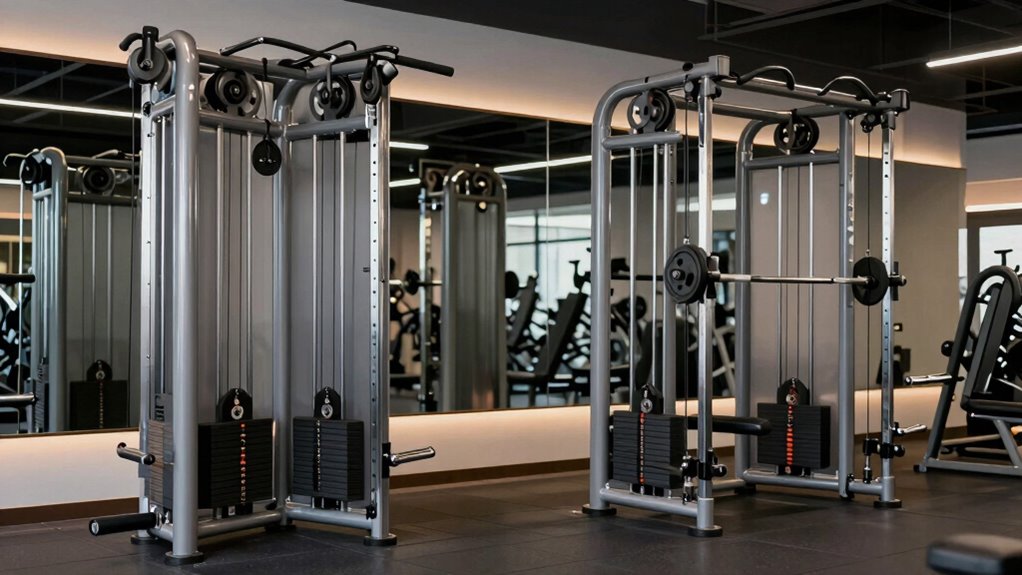
Cable machines are versatile fitness tools that use adjustable pulleys and weight stacks to target various muscle groups. Their cable versatility allows you to perform a wide range of exercises, from presses to pulls, all with a single device. You can easily modify resistance levels, giving you resistance customization that adapts to your strength and goals. This flexibility enables smooth, controlled movements, reducing the risk of injury and improving form. Whether you’re working on strength, stability, or flexibility, cable machines support diverse workout routines. Their adaptability makes them suitable for beginners and advanced athletes alike. Plus, they allow for constant tension throughout each movement, maximizing muscle engagement and making every rep count. Additionally, incorporating functional training principles with cable machines can enhance real-world movement patterns and overall athletic performance. Understanding muscle engagement during exercises can help optimize your workout effectiveness and prevent overtraining. Moreover, their ability to facilitate progressive overload ensures continual strength development over time. Incorporating these machines into your routine can also help improve muscular balance, reducing the risk of injury caused by muscular imbalances. Utilizing variety in exercises can keep workouts fresh and prevent plateaus, leading to sustained progress and motivation.
As an affiliate, we earn on qualifying purchases.
What Is a Functional Trainer and How Does It Support Your Workouts?
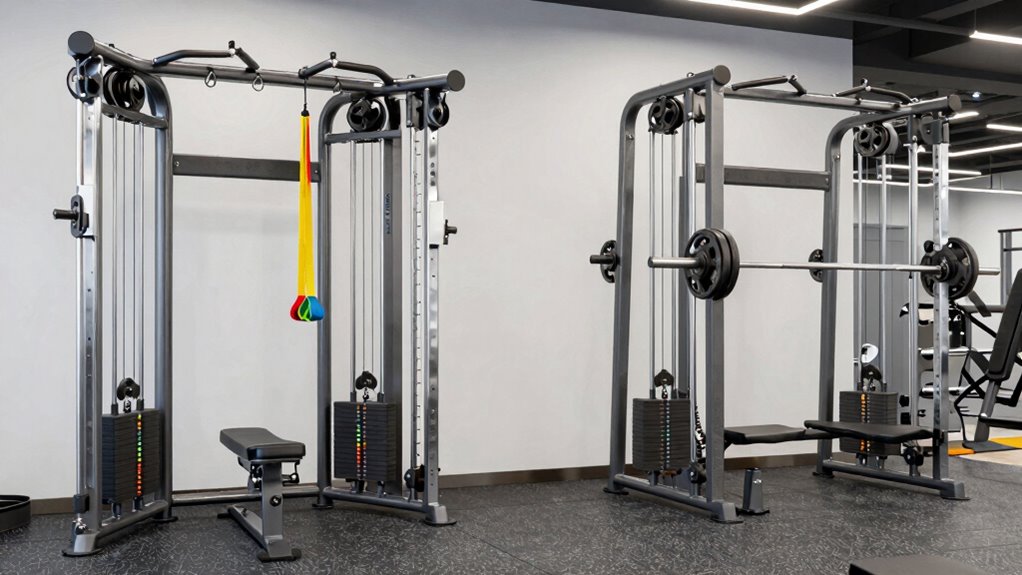
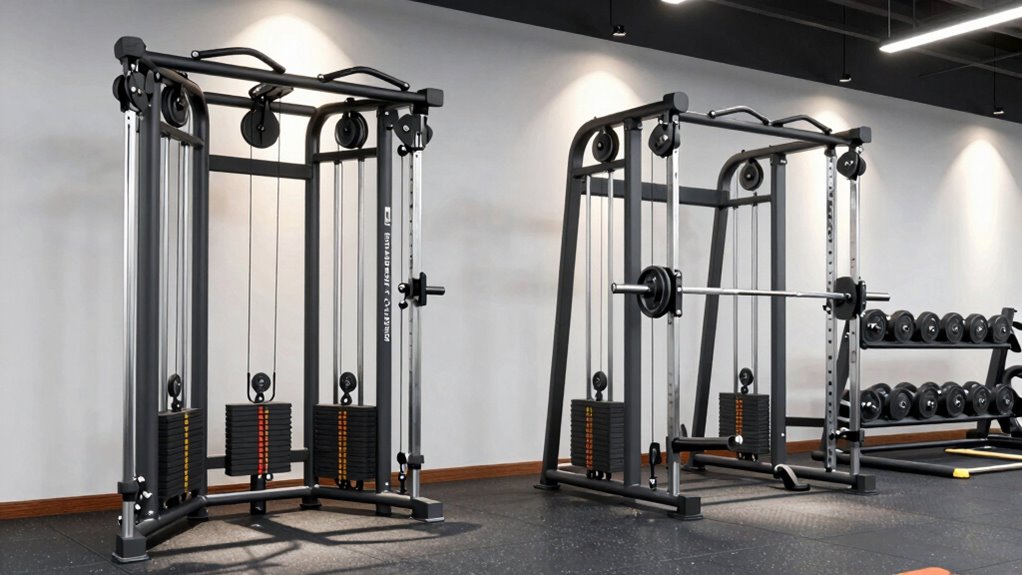
A functional trainer builds on the versatility of cable machines by offering multiple adjustable pulleys positioned at different heights, allowing you to perform a wide variety of movements in a single setup. This design enables you to target specific muscles with precision, supporting muscle isolation when needed. The independent pulleys provide excellent motion control, giving you smooth, customizable resistance throughout each exercise. With a functional trainer, you can perform functional movements that mimic real-life activities, enhancing overall strength and coordination. Its versatility makes it ideal for customizing workouts to your goals, whether you’re focusing on rehabilitation, strength, or endurance. Overall, a functional trainer supports dynamic, controlled workouts that improve muscle engagement and functional fitness.
As an affiliate, we earn on qualifying purchases.
What Are the Features and Benefits of the Smith Machine Combo?
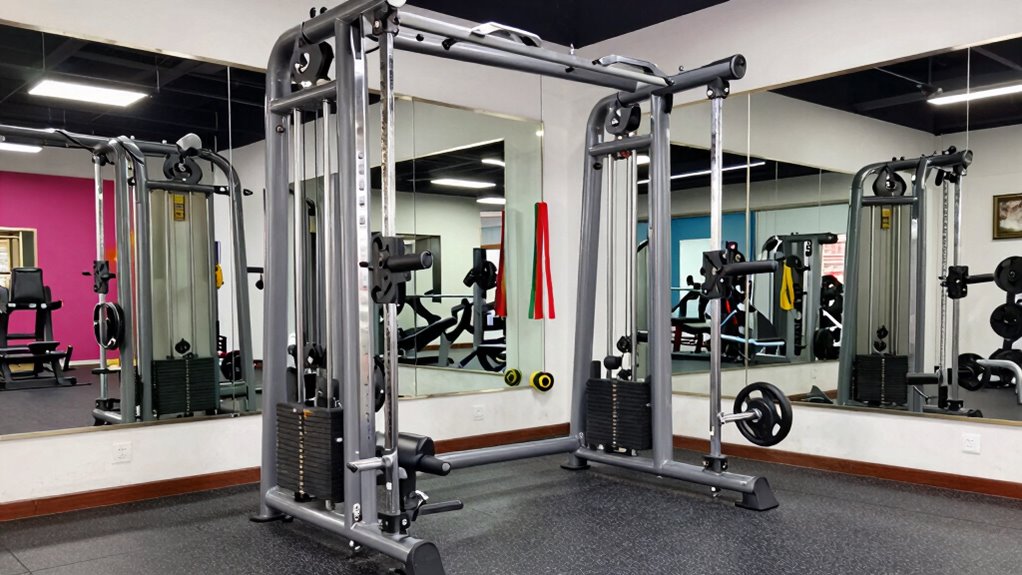
The Smith machine combo combines the stability of a traditional Smith machine with the versatility of additional functional attachments, making it a powerful all-in-one workout station. Its safety features, such as built-in catches and guided barbell movement, help prevent injuries and allow you to lift confidently, even alone. The design enhances user accessibility by providing adjustable components tailored to different heights and body types, ensuring a comfortable workout for everyone. You benefit from simplified setup and quick changes between exercises, saving time and maintaining momentum. The combo’s versatility allows you to perform a wide range of movements—squats, presses, rows—without needing multiple machines. Overall, it offers a safe, accessible, and efficient way to diversify your training and target multiple muscle groups effectively.
As an affiliate, we earn on qualifying purchases.
Which Equipment Offers More Exercise Options?
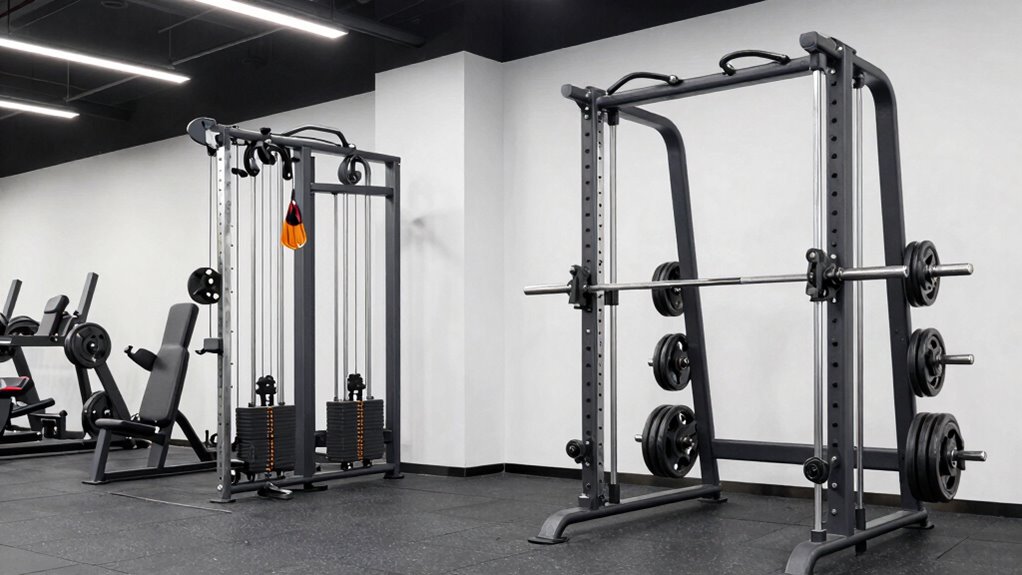
When it comes to exercise variety, cable machines generally offer more options than Smith machine combos. With a functional trainer, you can perform a wide range of movements, targeting different muscle groups from multiple angles. This flexibility allows you to customize workouts easily, increasing variety and engagement. Plus, cable machines prioritize machine safety and user comfort, providing smooth resistance adjustments that reduce strain or risk of injury. The adjustable pulleys and versatile attachments enable you to modify exercises based on your fitness level or specific goals. In contrast, Smith machine combos are more limited to fixed movements, which can restrict variety. Overall, if variety is a priority, cable machines give you more exercise options while maintaining safety and comfort.
How Do These Machines Engage Different Muscle Groups?
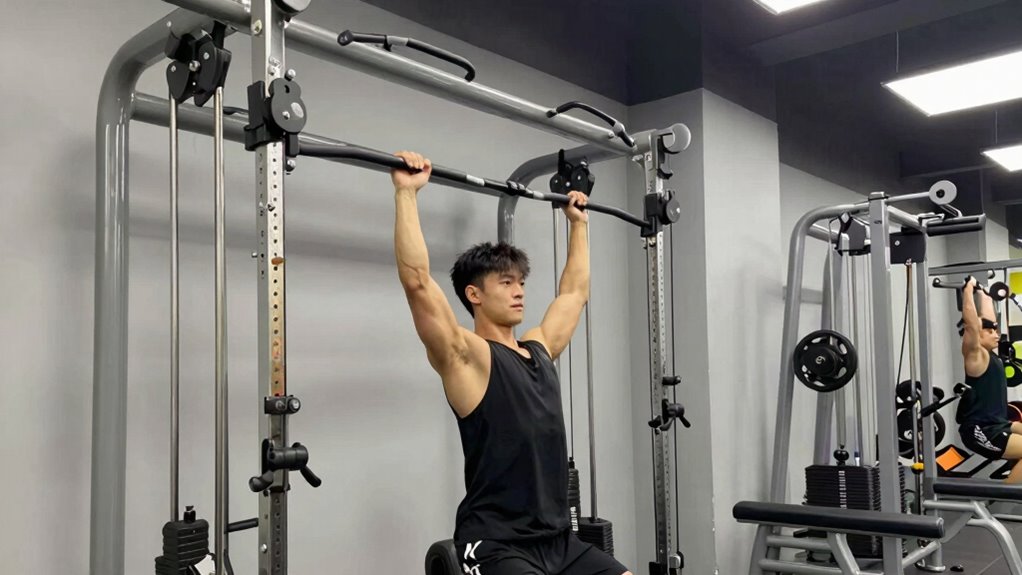
You’ll notice that the range of motion varies between these machines, affecting how muscles are activated during each exercise. The functional trainer allows for more natural, multi-directional movements, engaging multiple muscle groups at once. In contrast, the Smith machine‘s guided path targets specific muscles more directly, making it ideal for focused strength building.
Range of Motion Variability
While both cable machines and Smith machines allow for targeted muscle engagement, they differ markedly in their range of motion, which influences how they activate various muscle groups. Cable machines offer significant range variability, enabling you to move through multiple planes of motion. This motion diversity allows for more natural movements, engaging stabilizer muscles and promoting functional strength. Conversely, the Smith machine restricts movement to a fixed vertical path, limiting range variability. While this can be beneficial for safety and isolating specific muscles, it reduces the opportunity for muscles to adapt to varied movement patterns. As a result, cable machines provide a broader spectrum of motion, allowing you to challenge muscles in different ways and better mimic real-life activities.
Targeted Muscle Activation
Cable machines excel at isolating and activating specific muscle groups due to their adjustable pulleys and multi-directional movement. This setup allows you to target muscles precisely, enhancing muscle isolation and ensuring you engage the right areas. You can fine-tune angles and resistance to emphasize particular muscles while maintaining joint stability during each exercise. With the functional trainer, you can perform dynamic, multi-planar movements that activate multiple muscles simultaneously, promoting coordination. Conversely, the Smith combo offers more controlled, linear movements, focusing on joint stability and safer muscle activation. Additionally, cable machines facilitate controlled, safer training for specific muscle groups, helping prevent injury during workouts. Their versatility is especially valuable for functional movement training, which prepares the body for real-world activities and improves overall movement quality.
Can Functional Trainers and Smith Machines Support Different Workout Styles?
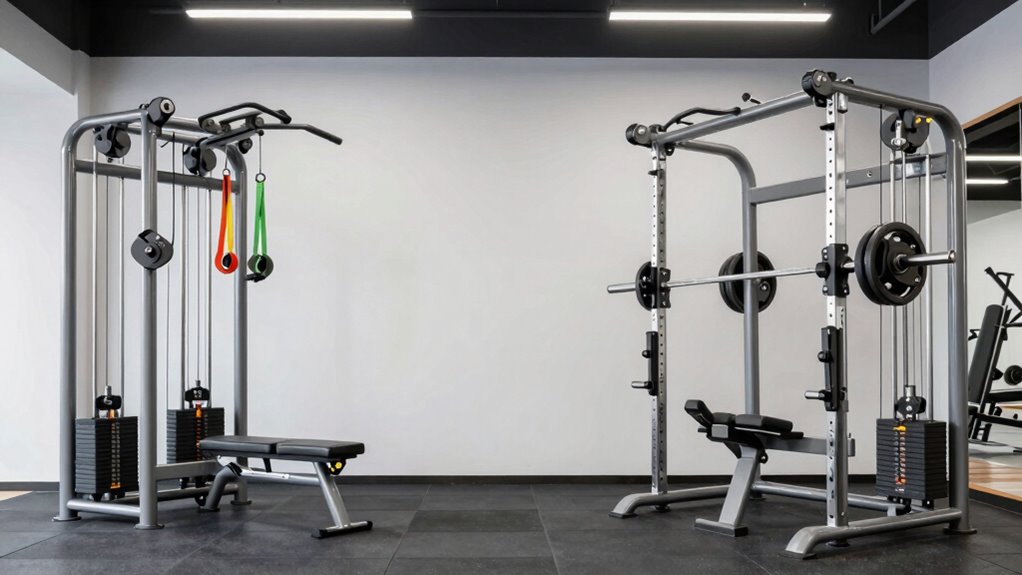
Both functional trainers and Smith machines are versatile gym equipment options that can support different workout styles, but they do so differently. Functional trainers excel at resistance training that mimics real-life movements, offering multiple planes of motion. They’re ideal for athletes or those focusing on mobility, stability, and versatility. Smith machines, on the other hand, support safer, controlled resistance training, perfect for beginners or heavy lifting. They promote stability and proper form, making them suitable for bodybuilding or strength-focused routines. Understanding exercise biomechanics can help you choose the right equipment for your fitness goals.
What Are the Space, Cost, and Setup Considerations for Home Gyms?
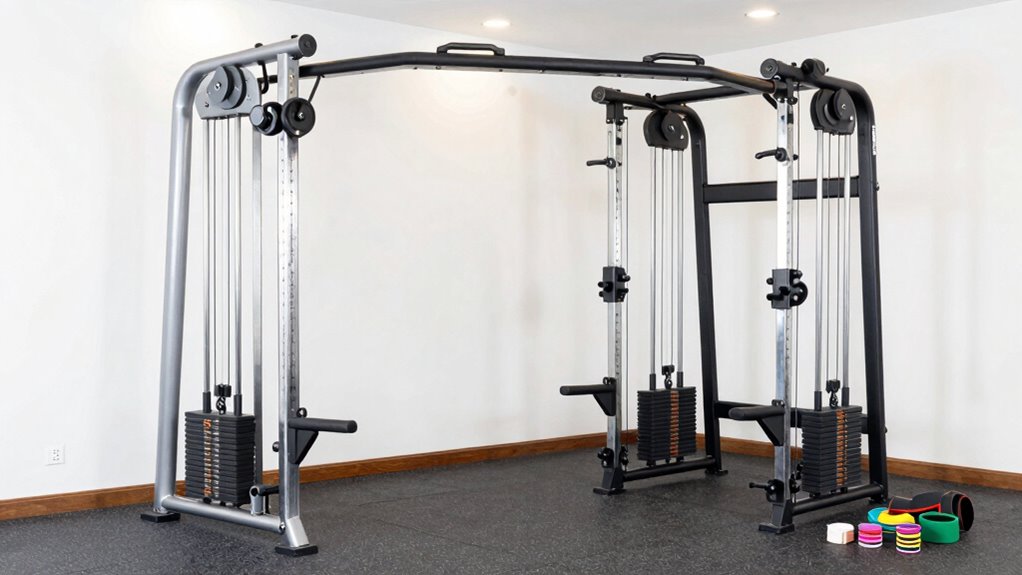
Setting up a home gym requires careful consideration of space, budget, and installation needs. To maximize space efficiency, choose compact machines or multi-use equipment that fit your area. Cost considerations are vital—balance your budget with quality gear to avoid future upgrades. Be mindful of setup requirements, including electrical outlets, flooring, and clear workout zones. Here are some key points to contemplate:
- Prioritize space-saving designs for small rooms
- Budget for initial purchase and ongoing maintenance
- Evaluate ease of installation and setup time
- Consider multi-functional machines for versatility
- Plan for proper flooring to protect your space
How Do These Machines Support Progressive Overload and Strength Gains?
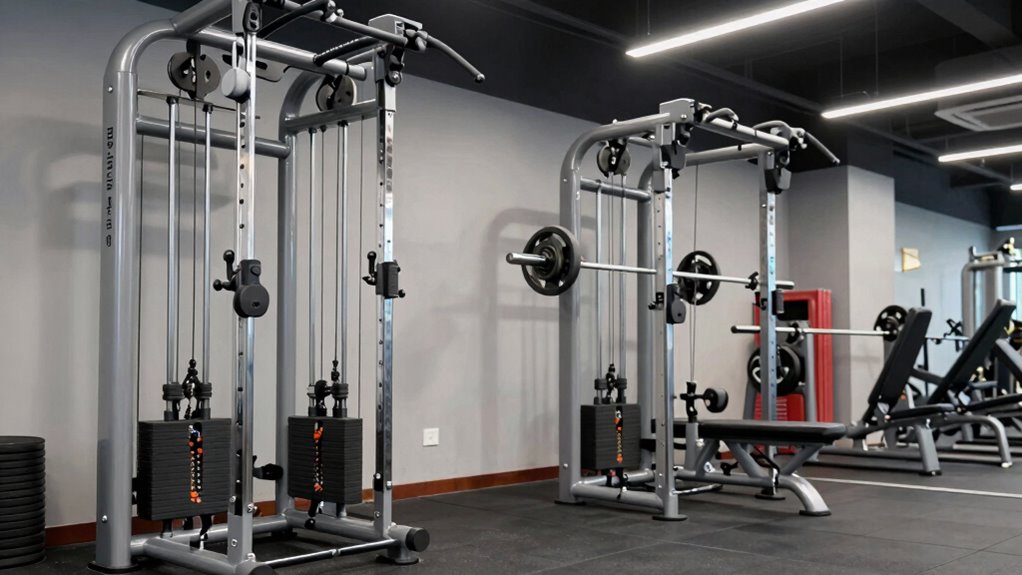
Both cable machines offer adjustable resistance levels, so you can gradually increase the load as your strength improves. Their versatile exercise options let you target different muscle groups and vary your routines to prevent plateaus. This flexibility makes it easier to implement progressive overload and keep making strength gains over time. Additionally, incorporating proper bedding can enhance recovery and overall performance by ensuring restful sleep. Understanding Gold IRA Rollovers can also diversify your investment portfolio, providing additional financial security. Incorporating regular maintenance into your workout routine can help ensure your equipment stays in top condition and continues to support your fitness progress. Exploring sound vibrations and their effects on cellular health can further optimize your training and recovery methods, especially when combined with recovery techniques.
Adjustable Resistance Levels
Adjustable resistance levels are key features that allow you to tailor your workout intensity and promote continuous strength development. By fine-tuning the resistance, you can challenge your muscles progressively, supporting steady gains. Both the functional trainer and Smith combo offer this capability, enhancing exercise versatility and ensuring you avoid plateaus. Incorporating high-quality components ensures durability and smooth adjustments during workouts. With adjustable resistance, you can:
- Gradually increase weights to push your limits
- Customize exercises for different muscle groups
- Ensure proper technique with manageable loads
- Vary intensity without changing equipment
- Track progress easily through resistance increments
These features empower you to personalize your workouts, making it easier to support progressive overload and optimize strength gains over time. The ability to modify resistance levels is essential for sustained muscle development and workout adaptability.
Versatile Exercise Options
Versatile exercise options are a major advantage of both functional trainers and Smith machines, enabling you to target different muscle groups and perform a wide range of movements. This variety supports progressive overload by allowing you to adjust resistance and adapt exercises over time, fostering continuous strength gains. Functional trainers excel at muscle isolation, helping you focus on specific muscles with controlled movements, which can reduce injury risk. Smith machines offer stability for safer lifts, especially when working with heavier weights, contributing to injury prevention. Both machines give you the flexibility to modify angles and positions, ensuring you can tailor workouts to your needs. This adaptability makes it easier to challenge yourself progressively while maintaining proper form and minimizing the chance of injury.
Which Equipment Is Easier to Use for Beginners?
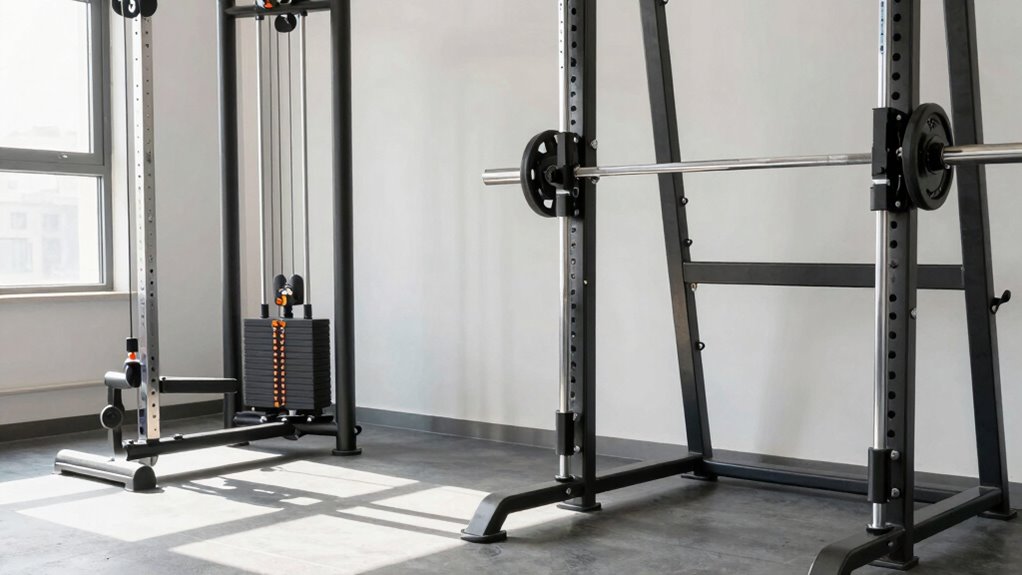
When you’re just starting out, choosing between a functional trainer and a Smith machine can seem overwhelming, but understanding their differences can make the decision easier. The ease of setup and user friendliness are key factors. A functional trainer typically offers more intuitive operation, with adjustable pulleys that are straightforward to use. It allows for natural movements, making it easier for beginners to get started. The Smith machine, on the other hand, has a fixed barbell that’s simple to position, but may feel less natural for beginners. Additionally, the auditory feedback provided by functional trainers can help users adjust their form in real-time. Consider these points:
- Functional trainers have quick adjustments for different exercises
- Smith machines have a clear, guided path for lifts
- Functional trainers often require less instruction
- Smith machines can feel more stable for beginners
- User friendliness depends on personal comfort level
Furthermore, the ease of use of each equipment can vary based on individual familiarity with gym equipment and personal learning curves. A learning curve can influence how quickly a beginner becomes comfortable and confident with each type of equipment. Understanding the market trends and features of these machines can also help in making an informed choice. Additionally, considering the versatility of each option can help beginners develop a more comprehensive workout routine.
Which Equipment Offers Greater Workout Variety?
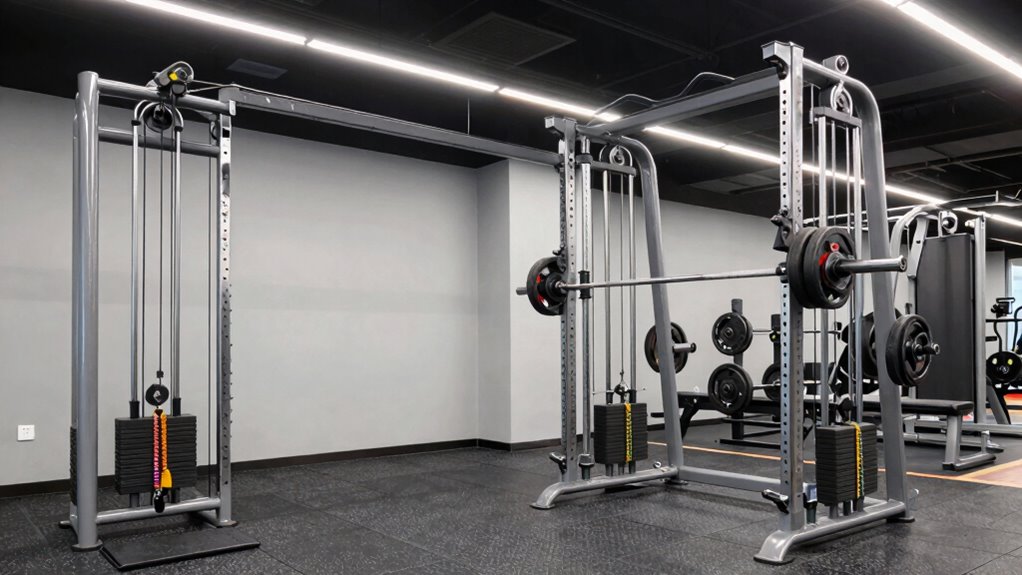
Both functional trainers and Smith machines can support a wide range of exercises, but the functional trainer generally offers greater workout variety. Its cable versatility allows you to perform countless movements, targeting different muscle groups with ease. You can adjust the pulleys to change angles, enabling dynamic, multi-directional exercises that challenge your stability and coordination. In contrast, Smith machines are more limited, mainly supporting fixed barbell movements. Additionally, functional trainers tend to have superior equipment durability, designed to withstand frequent use and diverse exercises. This durability guarantees consistent performance over time. If variety is your goal, a functional trainer provides a broader spectrum of workout options, making it easier to tailor routines and progress in multiple fitness areas. Furthermore, the diverse exercise options available with functional trainers align with the versatility of workout equipment that can adapt to various training needs, offering a range of engaging and emotionally resonant workout experiences.
Moreover, the ability of functional trainers to incorporate multiple movement patterns makes them a versatile choice for both beginners and advanced athletes seeking comprehensive training. This adaptability also supports functional fitness, which focuses on real-world movement skills beneficial for daily activities and overall health. Additionally, many models feature adjustable resistance and accessories, further expanding their training capabilities to suit individual goals.
Frequently Asked Questions
Can You Perform Olympic Lifts on These Machines?
You can perform Olympic lifts on some cable machines, but machine compatibility varies. Functional trainers often allow more natural movement patterns, making them better suited for lifts like cleans and snatches, while Smith machines offer guided paths that can limit the full range of Olympic lifts. For ideal results and safety, consider using free weights or specialized equipment designed specifically for Olympic lifts.
Are Cable Machines Suitable for Rehabilitation Exercises?
Yes, cable machines are highly suitable for rehabilitation exercises. Their versatility allows you to target specific muscles gently, aiding recovery and improving mobility. With adjustable resistance and multiple attachment options, they provide a safe, controlled environment for gradual strength rebuilding. If you’re wondering about machine suitability for rehab, cable machines often offer the flexibility you need to tailor exercises precisely to your recovery stage.
How Do These Machines Impact Joint Safety During Workouts?
Using cable machines can enhance joint safety during workouts by promoting joint stability and aiding injury prevention. They allow you to control movement patterns and resistance smoothly, reducing strain on your joints. This controlled environment helps minimize sudden or awkward motions that could cause injury. Whether you’re using a functional trainer or a Smith combo, focusing on proper form and gradual weight increases further safeguards your joints and supports long-term joint health.
Are There Specific Accessories That Enhance Their Versatility?
Yes, specific accessories can boost their versatility. You’ll find attachment options like handles, bars, ankle straps, and ropes that seamlessly fit both machines. These accessories enhance your workout variety, allowing you to target different muscle groups, adjust resistance, and customize exercises. By expanding accessory compatibility, you open up more exercise options and create a dynamic, full-body workout experience that keeps you motivated and challenged.
Which Machine Is Better for Explosive Power Training?
The functional trainer is better for explosive power training because it allows you to perform dynamic, multi-planar exercises that improve your speed and strength. Its versatility enhances training effectiveness, letting you incorporate explosive movements like plyometric pulls and rapid presses. The Smith combo’s controlled motions are less ideal for explosive work. For maximum results, choose the functional trainer to develop power efficiently and safely.
Conclusion
Choosing between a functional trainer and a Smith combo is like selecting a key to unfasten your fitness journey. The functional trainer, with its versatility, is your open door to endless exercises, while the Smith combo acts as a sturdy bridge guiding you safely across strength gains. Whichever you choose, remember it’s your commitment that fuels progress. Embrace the machine that best reflects your goals, and let it be the compass guiding your path to a stronger, healthier you.
Fall Picks
fall essentials
As an affiliate, we earn on qualifying purchases.