
TL;DR

Get health and wellness essentials delivered free with Prime
- Fast, free delivery on millions of items
- Prime Video, Amazon Music and more included
- Member-only deals all year
A Mayo Clinic Q&A with Dr. Kenton Kaufman describes balance as a function of several body systems that can change with age. It outlines possible causes of unsteadiness and suggests balance exercises, while advising people with serious balance problems to consult a health care professional before exercising.
A Mayo Clinic Q&A republished by Seniors Guide outlines how balance can change with age and describes ways older adults may practice steadiness. Dr. Kenton Kaufman, a Mayo Clinic researcher, says balance depends on several body systems working together; the report also notes that falls are the leading cause of injuries among adults 65 and older.
Kaufman, whose specialties listed in the report include orthopedic surgery, physiology and bioengineering, describes balance as a coordinated function involving the muscles, eyes, inner ear, nerves, heart and blood vessels. Changes in any of these systems may contribute to unsteadiness. The Q&A also says Mayo Clinic Motion Analysis Laboratory research suggests that standing on one leg can offer a measure of how the nervous system and muscles work together as people age.
The report lists possible signs of balance problems, including spinning sensations, lightheadedness, unsteadiness, falls, dizziness and blurred vision. It names a range of possible causes: inner-ear disorders, nerve damage in the legs, vision problems, neurological conditions such as Parkinson’s disease, and side effects from some medications. These are possibilities described in the Q&A, not a diagnosis of any individual’s symptoms.
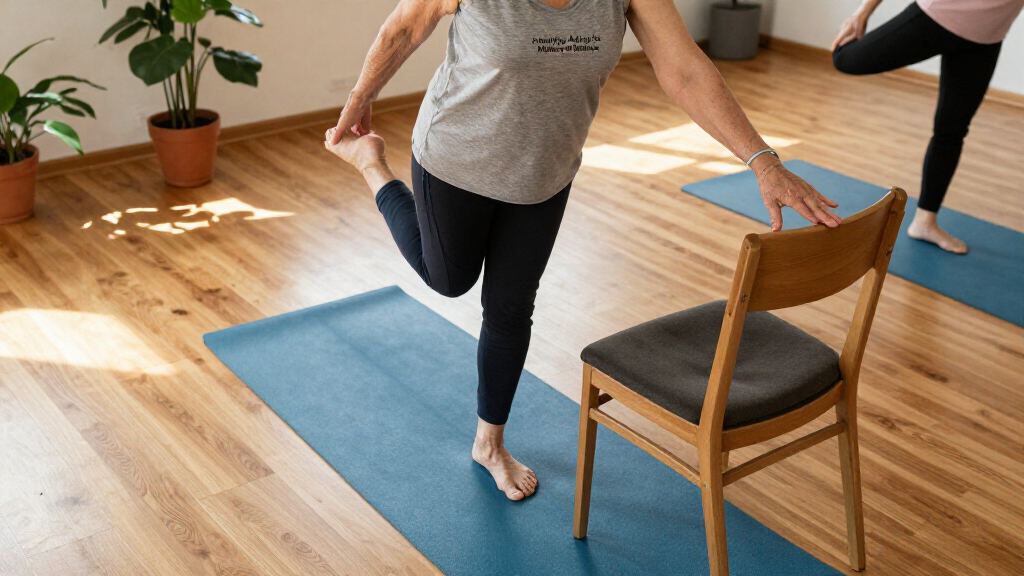
For practice, Kaufman suggests working with a physical therapist trained in balance issues or taking classes such as tai chi, yoga or Pilates. At home, the report recommends using a stable counter or table for support when needed. Examples include standing with feet close together, shifting weight from side to side, walking heel to toe, and standing on one foot during a simple task. It advises people with serious balance problems to check with a health care professional before starting balance exercises.
Balance, Falls and Daily Independence
Balance can affect more than whether someone feels steady. The Mayo Clinic Q&A links balance, muscle strength and gait—the way a person walks—with independence and well-being. Changes in these abilities may help clinicians shape programs for healthy aging, according to the report.
The falls information gives the issue practical importance: the source identifies unintentional falls, most often resulting from loss of balance, as the leading cause of injury among people aged 65 and older. That does not mean every episode of dizziness signals a serious condition, but recurring or troubling symptoms can have several possible explanations. The article encourages readers to seek professional guidance when balance problems are serious, rather than treating exercises as a substitute for medical care.
Products Worth Considering

Hyperice Normatec 3 Full-Leg Compression Boots, Standard Size

Blueair Blue Pure 511i Max Smart Air Purifier

Withings Body Scan Smart Scale with Segmental Body Composition and ECG, Black
As an affiliate, we earn on qualifying purchases.
How the Mayo Clinic Frames Balance
The source is an educational Mayo Clinic Q&A based on a reader’s question about feeling less steady in their early 60s. It was written by Kenton Kaufman and distributed by Tribune Content Agency; Seniors Guide republished it. The supplied material includes a 2025 copyright notice but does not give a specific publication date.
The Q&A presents balance as a combined function rather than a single ability. It says age-related deterioration can affect multiple systems involved in staying upright and walking. It also describes one-leg standing as a potential measure discussed in Mayo Clinic Motion Analysis Laboratory research, but does not provide study details or establish that the test alone can diagnose a condition or predict an individual’s risk.
“Your ability to balance on one leg can be a reliable measure of how well your nervous system and muscles are working together as you age.”
— Dr. Kenton Kaufman, Mayo Clinic
Limits of the Balance Test
The report does not provide the underlying research methods, sample size or evidence needed to assess how accurately a one-leg standing test predicts falls or measures aging. Its suggested time markers—standing unsupported for 30 seconds as a sign of good balance and being unable to hold for five seconds as a possible fall risk—are presented in the Q&A, but the source does not describe them as a clinical diagnosis.
It is also not possible to identify the cause of an individual’s balance changes from the article alone. The listed causes range from inner-ear and vision problems to neurological conditions and medication effects. The report does not specify how quickly symptoms require care or offer individualized exercise plans; those decisions depend on a person’s health and circumstances.
When to Seek Individual Guidance
The Q&A does not announce a new study, policy or scheduled follow-up. Its practical guidance is to consider a physical therapist trained in balance problems for a tailored program, and to consult a health care professional before attempting exercises if balance problems are serious. Readers experiencing unsteadiness can discuss their symptoms and medications with a qualified professional, who can determine whether further evaluation is appropriate.
Any exercise should be adapted to a person’s ability and performed with stable support when needed, as the source advises. The Mayo Clinic notice also states that the educational Q&A is not a replacement for regular medical care.
Key Questions
What systems contribute to balance?
The Q&A says balance relies on several systems working together, including the muscles, eyes, inner ear, nerves, heart and blood vessels.
What can cause unsteadiness as people age?
The report lists possible causes including inner-ear problems, leg nerve damage, vision changes, neurological conditions and side effects from some medications. The article cannot determine the cause for a particular person.
What balance exercises does the report suggest?
Examples include shifting weight from side to side, walking heel to toe and standing on one foot during a simple task. Kaufman recommends using a stable counter or table for support if needed.
Should someone with serious balance problems exercise at home?
The Q&A advises people with serious balance problems to check with a health care professional before doing balance exercises. A physical therapist trained in balance issues may design a tailored program.
Source: rss