
TL;DR

Get health and wellness essentials delivered free with Prime
- Fast, free delivery on millions of items
- Prime Video, Amazon Music and more included
- Member-only deals all year
A Sixty and Me report argues that stiffness later in life is not necessarily caused by age alone: prolonged sitting and repeating a narrow range of movements may also contribute. The report’s Pilates instructor says gentle movement can ease some stiffness, but the article is based on her teaching experience, not a clinical study.
A Sixty and Me report says stiffness after 60 may be linked not only to age but also to long periods of sitting and using the body in a limited range of ways. The account comes from a Pilates instructor who has taught women over 55 for more than 10 years; it reflects her observations in classes, rather than findings from a clinical study.
The instructor says people who arrive at class feeling stiff are often those who have been sitting more than usual, such as after a long drive, a weekend of reading or extended computer work. In her experience, some of the stiffness eases after movement, though she says it does not all disappear. The report does not quantify how often this occurs or establish that sitting is the cause.
She also points to the kinds of movement people repeat during ordinary days. Sitting, walking forward, reaching for nearby objects and bending for household tasks can make up much of that routine, while reaching overhead or leaning sideways may happen less often. The instructor says this pattern can leave people feeling less comfortable in movements they rarely use.
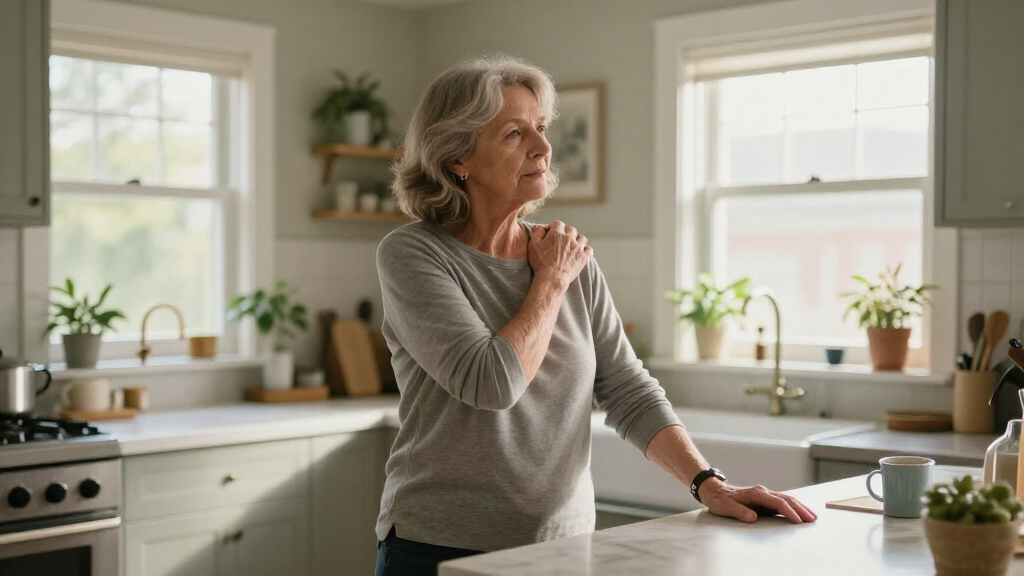
The report describes stiffness in the neck, shoulders, upper back, hips and spine, including turning the head, reaching to a high shelf, getting in and out of a car, or bending to tie shoes. These are examples from the instructor’s account, not a checklist that identifies the cause of an individual’s symptoms.
How Daily Movement May Shape Stiffness
The report offers readers a reason to look beyond age alone when noticing stiffness: daily routines and time spent sitting may be relevant factors. That can help people pay attention to whether discomfort follows a long period in one position, though the source does not show that changing movement habits will resolve persistent or severe symptoms.
The instructor recommends starting with slow, comfortable movement, followed by work on stability and then strength. Her explanation is based on how she structures Pilates classes and what students tell her; the source does not compare this sequence with other approaches or provide trial results. Readers should not treat the report as a diagnosis or a substitute for individualized medical guidance.
As an affiliate, we earn on qualifying purchases.
The Instructor’s Mobility Approach
The instructor says her classes begin with easy movements intended to get stiff areas moving, then focus on stability around joints before progressing to strength work. She reports that students often tell her they feel looser after class and notice a difference when they miss a week. These are anecdotal observations, not measured outcomes.
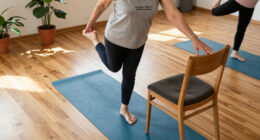
For readers who want to try a brief routine, the report suggests doing movements while seated upright in a sturdy chair and staying within a comfortable range. It lists slow neck turns, shoulder rolls, seated cat-cow movements and alternating knee lifts. The instructor advises against pushing into pain and says people with a specific injury or health condition should check with a doctor before starting something new.
As an affiliate, we earn on qualifying purchases.
What the Report Does Not Establish
The source is an instructor’s account of her experience, and it does not cite a study, medical authority or data comparing stiffness across age groups. It therefore cannot establish how much sitting contributes to stiffness, whether the effect differs by person, or how much a short routine changes symptoms over time.
Stiffness can have different causes, and the report does not assess any reader’s health or distinguish ordinary stiffness from symptoms connected to an injury or condition. It also gives no guidance about what to do when stiffness is persistent, worsening or accompanied by other symptoms. Those questions require advice suited to the individual.
As an affiliate, we earn on qualifying purchases.
Practical Steps and Medical Guidance
The report suggests trying its five-minute seated routine in the morning or after sitting, moving slowly and staying within a comfortable range. It recommends checking with a doctor before starting a new routine if a person has an injury or health condition. The source does not report a formal follow-up or a plan to measure results.
Readers can observe whether stiffness tends to follow particular activities, but the article’s examples should not be treated as proof of cause. Anyone concerned about stiffness or unsure which movements are appropriate can seek guidance from a qualified health professional.
As an affiliate, we earn on qualifying purchases.
Key Questions
Does the report say stiffness after 60 is not caused by age?
No. It says age is not the only possible factor and points to sitting and limited movement as potential contributors based on the instructor’s experience. It does not measure the relative role of age or other causes.
What movements does the report suggest?
It lists slow neck turns, shoulder rolls, seated cat-cow movements and alternating seated knee lifts. The instructor says to move comfortably, not push into pain, and check with a doctor before trying something new when there is an injury or health condition.
Is the article based on a medical study?
The supplied source describes a Pilates instructor’s experience teaching women over 55. It does not cite a clinical study or provide measured results, so its claims about sitting and movement are observations, not proof of cause.
What should someone do if their stiffness concerns them?
The report does not offer an individual assessment. A person who is concerned, has an injury or health condition, or is unsure which movements are appropriate should ask a qualified health professional for guidance.
Source: rss
Cold & flu season Picks
humidifiers
As an affiliate, we earn on qualifying purchases.