
Understanding your hair’s porosity reveals a key to healthier, more manageable hair. If you know whether your cuticles are tight, smooth, or damaged, you can choose the right products and routines for moisture, shine, and protection. High porosity needs sealing oils, while low porosity benefits from lightweight, penetrating formulas. Getting your porosity right stops guesswork and helps your hair look its best. Keep exploring to discover how tailoring your routine to your porosity makes all the difference.

Get health and wellness essentials delivered free with Prime
- Fast, free delivery on millions of items
- Prime Video, Amazon Music and more included
- Member-only deals all year
Key Takeaways
- Understanding your hair’s porosity helps tailor products and routines for optimal moisture retention and hair health.
- High porosity hair needs sealing oils and deep conditioning, while low porosity benefits from lightweight, penetrating products.
- Regular porosity tests reveal changes, allowing adjustments for better manageability and damage prevention.
- Damaged cuticles cause uneven porosity, leading to dryness and frizz; maintaining cuticle health is essential.
- Recognizing porosity as a key factor fills gaps in hair routines, promoting stronger, shinier, and more resilient hair.
Have you ever wondered why some hair absorbs moisture quickly while others resist it? The secret often lies in your hair’s porosity, a key factor that many overlook when building their hair routines. Understanding your hair’s porosity can reveal the true potential of your products and help you achieve healthier, more manageable strands. When you pay attention to cuticle health and perform simple porosity testing, you gain insights into how your hair interacts with moisture and treatments.
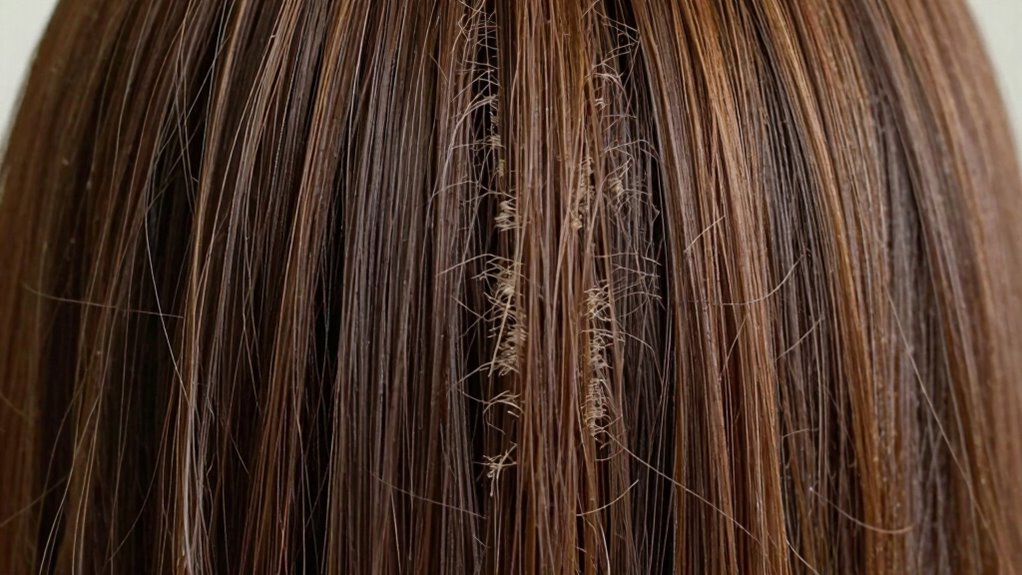
Your hair’s cuticle is the outermost layer that protects the inner cortex. Its condition directly influences your hair’s porosity. If your cuticles are smooth and tightly closed, your hair has low porosity, making it resistant to moisture absorption and product penetration. Conversely, if your cuticles are raised or damaged, your hair displays high porosity, allowing moisture to enter quickly but also escape just as fast. Maintaining cuticle health is essential because damaged cuticles lead to uneven porosity, resulting in dryness, frizz, and difficulty managing your hair. Using gentle, nourishing products that strengthen and smooth the cuticle can improve overall porosity and hair health.
A healthy cuticle ensures balanced porosity, promoting smooth, manageable, and resilient hair.
To determine your hair’s porosity, simple porosity testing methods can provide valuable insights. One common test involves placing a few strands of clean, dry hair in a glass of water. If the hair sinks quickly, you likely have high porosity. If it floats or takes a long time to sink, your hair probably has low porosity. Another method is the “slide test”: gently running your fingers over a strand of hair. If you feel roughness or small bumps, your cuticle may be raised, indicating higher porosity. These tests are quick, non-invasive, and help you tailor your hair care routine to suit your specific needs. Additionally, understanding hair porosity can help you select the most effective products and treatments for your hair type.
Once you understand your porosity level, you can choose products that work best for your hair. For high porosity hair, focus on moisturizing and sealing in hydration with oils and creams that help smooth the cuticle. For low porosity hair, lightweight and penetrating products are ideal, as they can easily pass through the tightly closed cuticles. Regularly evaluating cuticle health and testing your porosity keeps your hair routine dynamic and responsive. It allows you to address issues like dryness, brittleness, or excessive oiliness more effectively, rather than applying generic solutions that may not suit your hair’s unique needs.
In the end, knowing your hair’s porosity and maintaining healthy cuticles isn’t just about better moisture retention. It’s about understanding your hair on a deeper level, so you can optimize your routine, enhance your hair’s natural beauty, and prevent damage before it happens. Becoming familiar with these concepts empowers you to take control of your hair health, making each styling session more successful and your hair more resilient over time.
As an affiliate, we earn on qualifying purchases.
Frequently Asked Questions
How Often Should I Test My Hair Porosity?
You should test your hair porosity every few months to keep your routine on point. Regular hair porosity testing helps you understand any changes in how your hair absorbs moisture, which can vary with seasons, product use, or damage. Typically, testing every 3 to 6 months is enough unless you notice a sudden change in your hair’s texture or moisture levels. Staying consistent guarantees you adapt your routine effectively.
Can Hair Porosity Change Over Time?
Porosity can definitely shift over time as your hair ages or experiences damage. You might notice your hair becoming more porous, absorbing moisture quickly, or less porous, resisting hydration. These changes happen due to environmental factors, chemical treatments, or natural aging. Stay attentive to your hair’s evolving needs, and adjust your routine accordingly, because understanding porosity shifts helps you maintain healthy, hydrated hair at every stage of life.
Does Porosity Affect Hair Color Treatments?
Yes, your hair porosity affects color treatment absorption and hair dye compatibility. If you have high porosity, your hair absorbs color quickly but may fade faster, so you should choose gentle, hydrating dyes. Low porosity hair resists color, making it harder for treatments to penetrate. Understanding your porosity helps you select the right products, ensuring vibrant, long-lasting results and minimizing damage during coloring.
Are Certain Hair Porosity Types More Prone to Damage?
You might find that high porosity hair tends to be more damage susceptible because its cuticles are more open, making it easier to lose moisture and become fragile. This means it’s especially important to choose products compatible with your hair’s needs to minimize damage. Low porosity hair, however, often resists damage better, but still benefits from gentle treatments. Understanding your porosity helps you tailor your routine for healthier, happier hair.
How Does Climate Influence Hair Porosity?
Climate considerably influences your hair porosity by affecting moisture retention and product absorption. In humid environments, high moisture levels can make low porosity hair harder to hydrate, leading to product buildup. Conversely, dry or cold climates strip moisture from high porosity hair, causing it to become brittle and absorb products quickly. Understanding your climate helps you select the right products and routines to optimize moisture retention and maintain healthy hair.
moisturizing sealing oils for high porosity hair
As an affiliate, we earn on qualifying purchases.
As an affiliate, we earn on qualifying purchases.
Conclusion
Understanding your hair porosity is the key to revealing healthier, more manageable hair. Did you know that over 50% of people have hair with high or low porosity, making their hair more prone to damage or dryness? By identifying your porosity, you can tailor your routine, improve moisture retention, and reduce breakage. Don’t overlook this essential piece—knowing your hair’s porosity could be the game-changer your routine needs for truly radiant, resilient hair.
lightweight leave-in conditioner for low porosity hair
As an affiliate, we earn on qualifying purchases.
As an affiliate, we earn on qualifying purchases.
deep conditioning treatment for damaged hair
As an affiliate, we earn on qualifying purchases.
As an affiliate, we earn on qualifying purchases.
Fall Picks
fall essentials
As an affiliate, we earn on qualifying purchases.